
The leak is bad because it shows the State Department used a foreign-propaganda office against Americans, then lied to Congress about it.
— bitchuneedsoap (@uneedsoap) August 21, 2026
What GEC was allowed to do
Congress built the Global Engagement Center to counter foreign state and terrorist propaganda (22 U.S.C. § 2656… https://t.co/1U3FGRfpkk
The leak is bad because it shows the State Department used a foreign-propaganda office against Americans, then lied to Congress about it.
What GEC was allowed to do
Congress built the Global Engagement Center to counter foreign state and terrorist propaganda (22 U.S.C. § 2656 note). Russia, China, Iran, ISIS. Overseas. Not your uncle’s Facebook.
The First Amendment is the wall. State does not get to police domestic political speech. That’s why GEC’s own people told Congress in 2023 they “do not do any work domestically.”
Rogers’ papers say that was false.
What the papers show they did
1. They outsourced the illegal part.
In 2020 GEC plugged into the Election Integrity Partnership - Stanford, University of Washington, Graphika, Atlantic Council. House Judiciary already documented CISA and GEC helping stand that up so government could “launder” censorship past the First Amendment. Stamos admitted EIP existed to do what government lacked legal authorization to do.
Rogers’ internals make it operational, not theoretical: a GEC staffer on EIP nearly full time, in the ticket system, on Slack with a personal Gmail. That’s not “we sent a liaison to a briefing.” That’s State sitting in the takedown queue.
Tickets went to platforms. Platforms pulled posts. That’s the government speaking through a university so it doesn’t have to put a http://State.gov letterhead on “delete this American.”
2. The “foreign” excuse was a decoy.
EIP’s own report: every “repeat spreader” they named on Twitter was an American right-of-center account. Under 1% of claims involved foreign actors.
So the office chartered to fight Moscow spent the election working Americans. That’s the crime of the cover story. If it’s foreign, they have a statute. If it’s domestic, they need a warrant or they need to shut up. They picked a third option: call the American right “disinfo” and route it through EIP.
3. They hit a real political video and called it security.
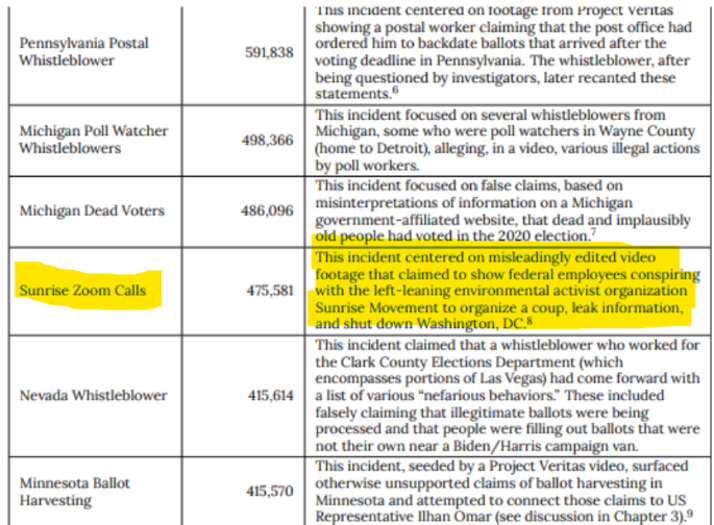
Sunrise Zoom calls, November 2020: BLM / Shutdown DC planning resistance if Trump won. Citizen journalists posted it. YouTube killed it. Rogers’ file: GEC flagged it, EIP made it a top narrative, ~500k tweets tracked. Stamos to platforms: we’re writing this up as disinformation, act before we drop that.
Whether you like those activists is irrelevant. A State Department foreign-influence shop submitting domestic protest planning for deletion is the government picking winners in American politics. “You might want to act soon” is a threat with a Stanford return address.
The staffer admitted they couldn’t act because it was domestic - then submitted the URLs anyway. That’s consciousness of guilt in an email.
4. They turned dissent into a “gendered foreign op.”
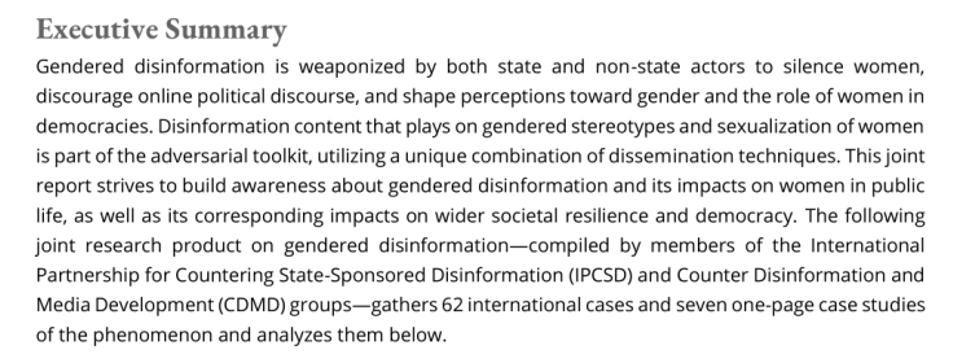
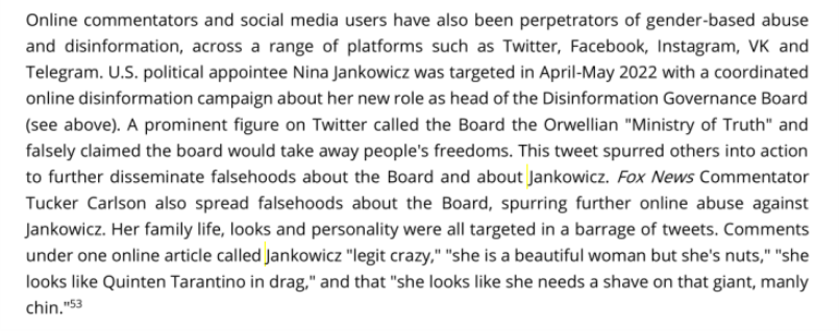
July 2022 GEC report with EU/EEAS partners on “gendered disinformation.” They treated insults, Tucker, “Ministry of Truth,” jokes about Nina Jancowicz as if GRU wrote them.
Jancowicz lasted weeks at DHS’s Disinformation Governance Board. The country laughed it out of the building. GEC’s move: file the laughter as a disinfo campaign against a woman, not as voters rejecting a speech cop. Internally they circulated the same doubts (Steele, Hunter laptop, her Trump comments). Publicly they pathologized the public.
That’s how you criminalize opposition without a statute. You don’t ban the speech. You label it a security incident and a gendered attack, then share it with foreign partners as if Americans criticizing a Biden appointee were a Kremlin product.
5. They told Congress the opposite.
October 2023: GEC sworn line is no domestic work. These records are domestic work. That’s not a policy disagreement. That’s oversight getting played. Then they sent the Hill a copy stamped not for public release, so the proof of the lie sits in a drawer.
Why this is worse than “Twitter Files already said that”
Twitter Files showed the machine. This is State authenticating GEC’s seat at the table with internal emails, a GEC-authored report, and a congressional stamp.
House Judiciary (Nov 2023) already said GEC + CISA + Stanford. Lawsuits (Missouri v. Biden, Daily Wire/Federalist v. State) already said GEC funded/partnered with censors (GDI, NewsGuard, EIP). Congress let GEC’s authorization die Dec 23, 2024 for this reason.
Rogers’ drop is the autopsy photos: the full-time staffer, the Gmail workaround, the “we can’t act / submit anyway” ticket, the Jancowicz binder, the lie to the Hill.
A foreign-influence office that targets Americans is not defending the country. It is running an information op on the country, with a university cutout and a gender studies alibi.
That’s why it’s bad. Not because the emails are spicy. Because the statute, the Constitution, and the testimony to Congress all said they couldn’t do this and they did it anyway.
The Receipts from Under Secretary of State Sarah B. Rogers:
@DataRepublican lol, these are my text messages and documents. The "markings" are FOIA redactions required even for voluntary disclosure. To prove this isn't a "trap," I will happily disclose the documents myself. Here they are (1/x):An internal Global Engagement Center report, never before public, reveals how the former State Department office worked with foreign governments to monitor so-called “gendered disinformation.” When doing so, GEC betrayed their stated mission and targeted domestic criticism of a Biden administration appointee. ⬇️@DataRepublican In a congressional hearing in October 2023, the Deputy Coordinator of GEC emphasized that the State Department entity “does not do any work domestically.”
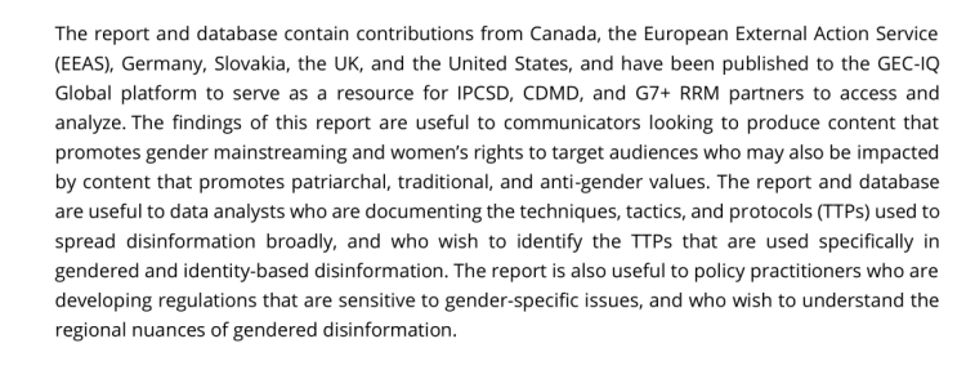
That was a lie.@DataRepublican GEC had an explicitly foreign-facing mandate – to identify and expose real, coordinated threats from foreign adversaries, propaganda that was detrimental to national security interests.@DataRepublican GEC worked with international partners to collect examples of so-called “gendered disinformation” for their report, dated July 2022.
They framed the issue as if crude stereotypes and online insults were the work of coordinated foreign threat actors.The report and a corresponding database, only available to U.S. officials and foreign government counterparts, were developed to inform responses to “patriarchal, traditional, and anti-gender values”, and the development of regulations “that are sensitive to gender-specific issues.”This "gendered disinformation" project unfolded at GEC as the Biden administration faced intense backlash from lawmakers and the American public over the creation of an adjacent censorship effort at the Department of Homeland Security: the short-lived Disinformation Governance Board (DGB).Biden appointee Nina Jancowicz resigned from her position as Director of the Board after just weeks on the job, and the DGB was disbanded altogether in August 2022 following the recommendation of the Administration's own Homeland Security Advisory Council.
Following HSAC Recommendation, DHS terminates Disinformation Governance Board | Homeland SecurityStatement from the Department of Homeland Security following the recommendation from the Homeland Security Advisory Council regarding the Disinformation Governance Boardhttps://www.dhs.gov/archive/news/2022/08/24/following-hsac-recommendation-dhs-terminates-disinformation-governance-boardThe closure of the DHS's Disinformation Governance Board vindicated the American public's concern over the Biden administration's involvement in domestic censorship conducted under the guise of countering "disinformation." GEC labeled this backlash – American discourse and inconvenient criticisms about their DHS counterpart – as an example of "gendered disinformation" that "led to a substantial direct impact in the United States."
Note: this screenshot was previously provided *in another context* "not for public release," but we have the discretion to release it now:The closure of the DHS's Disinformation Governance Board vindicated the American public's concern over the Biden administration's involvement in domestic censorship conducted under the guise of countering "disinformation." GEC labeled this backlash – American discourse and inconvenient criticisms about their DHS counterpart – as an example of "gendered disinformation" that "led to a substantial direct impact in the United States."
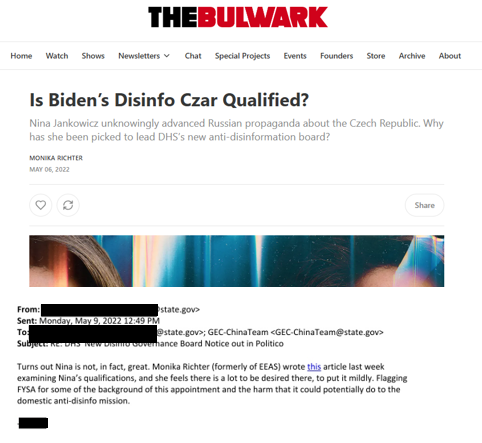
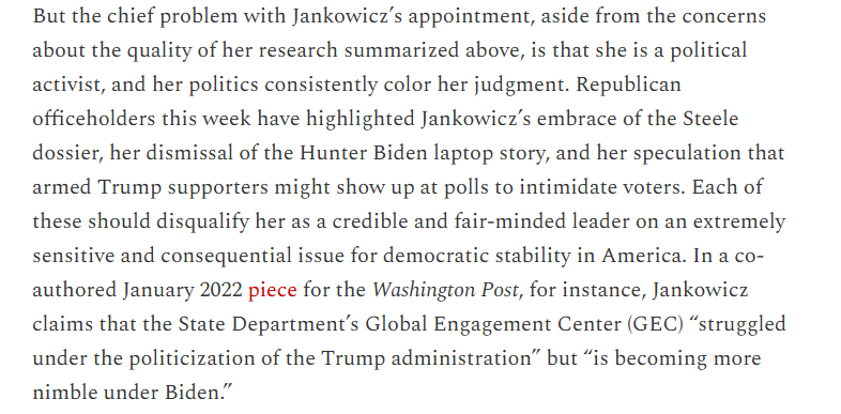
Note: this screenshot was previously provided *in another context* "not for public release," but we have the discretion to release it now:@DataRepublican They insisted the closure of the DHS Disinformation Governance Board itself was not because of legitimate concern from the American public, but from "political and gendered disinformation" targeted at Jancowicz.References to the DGB as “the Ministry of Truth,” concerns that “the board would take away people’s freedoms,” coverage by Tucker Carlson on Fox News (at the time one of the most popular mainstream American news anchors), and even online comments calling Jancowicz “crazy” and that “she needs a shave on that giant, manly chin,” were all cited as part of the so-called “disinformation narrative.” In reality, these were simply Americans exercising their First Amendment rights to express concerns and opinions.@DataRepublican GEC's labeling of Jancowicz criticism as the fault of "gendered disinformation" is even more stunning when one considers the fact that, among themselves, officials shared similar concerns as the American public about her qualifications.Amid Jancowicz’s resignation in 2022, a GEC staffer shared an article written by a former official from the EEAS (GEC's same EU collaborator on the "gendered disinformation report" ) which criticized Jancowicz’s research as so deeply flawed that she unknowingly advanced propaganda narratives she purported to fight against.The author of the report, herself a “disinformation” professional, noted that Jancowicz was a “political activist” who was too influenced by her personal politics. The author cited Jancowicz’s support for the Steele dossier, dismissal of the Hunter Biden laptop story, and politically charged comments about President Trump as disqualifying for her career.@DataRepublicanGEC’s PARTICIPATION IN 2020 ELECTION CENSORSHIP-BY-PROXY OPERATION
The Election Integrity Partnership (EIP) styled itself as an academic nongovernmental effort to study election misinformation. In practice, it functioned as a government censorship-by-proxy operation during the 2020 election.
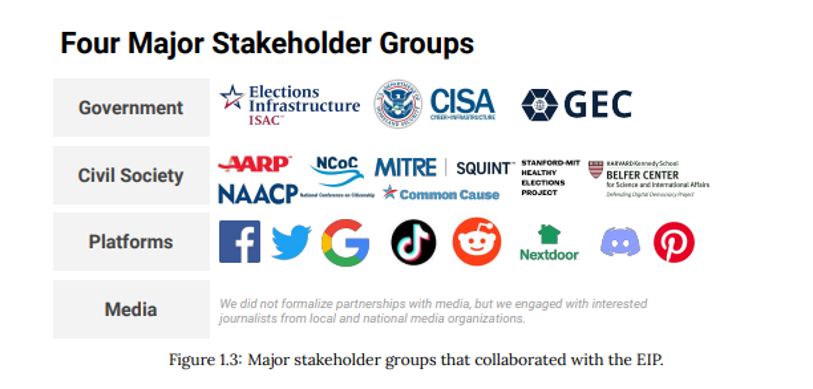
The State Department’s Global Engagement Center was heavily involved.@DataRepublican EIP was led by Stanford’s now-defunct “Internet Observatory” – joined by the University of Washington’s Center for an Informed Public, private analytics firm Graphika, and the Atlantic Council’s Digital Forensics Research Lab.This consortium operated through a system where stakeholders – notably the Department of Homeland Security’s CISA and State Department’s GEC – submitted "tickets” with URLs of social media content deemed to contain “mis- or dis- information.” The EIP routed this content to moderators at social media platforms for further action.@DataRepublicanEIP overtly focused on domestic election content, not foreign. Their own report confirms this.
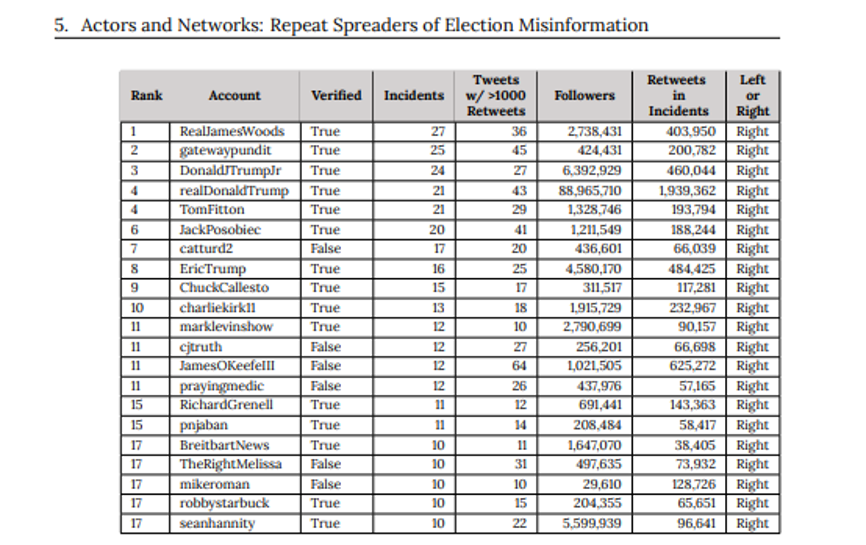
Every single “repeat spreader” of “misinformation” identified by the EIP on Twitter was an American, right-of-center account. So-called fact-checkers recognized GEC’s foreign-facing mandate and that “less than 1% of claims investigated by the partnership involved foreign actors.”When the “fact-checker” originally reached out for comment about GEC's involvement in the EIP, the extent of the GEC-EIP partnership seemed explanatory by the nature of both organizations: EIP dealt with domestic election speech online, while GEC was only authorized to deal with foreignadversarial propaganda. On this basis, GEC could claim their involvement in EIP was “limited” without further scrutiny.
But internal records tell a different story...@DataRepublicanFor starters: the U.S. government cannot compel social media platforms to take down lawful domestic political content. That's basic First Amendment stuff.
Again: GEC, as an office of the State Department, had a legally narrow mission: to monitor foreign adversarial propaganda – coordinated influence operations from Russia, China, Iran, etc. - not domestic content and social media accounts.The workaround for GEC to target domestic content during the 2020 election season? Outsource the censorship work to university labs and NGOs comprising the EIP.
EIP Director Alex Stamos himself admitted the EIP existed to “fill the gap of things that the government could not do themselves”, because the government lacked the “legal authorizations” to engage in domestic censorship work directly... because doing so would be a clear violation of the First Amendment.
[rumble.com/v1nd5vy-eip-fi…Internal emails shatter the idea that GEC’s involvement was “limited” or conducted solely within the scope of their mandate to track foreign propaganda.
As the 2020 elections approached, a GEC staffer worked “nearly full time” on the EIP up until election day. Directly integrated into the EIP’s ticket system, they also provided a personal Gmail address to join an EIP Slack channel days before the election.@DataRepublicanThis GEC-EIP staffer egregiously violated their foreign-facing authorities, flagging domestic political content directly to the EIP’s tipline.
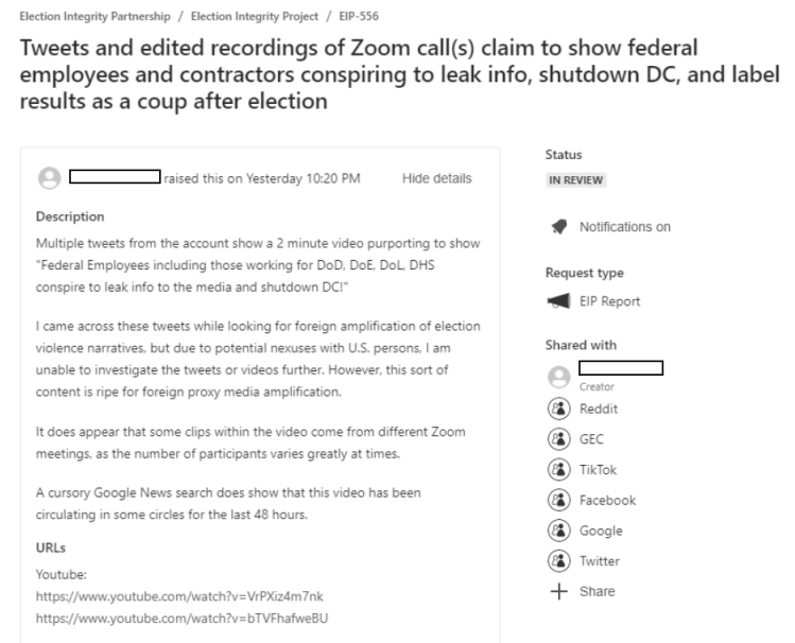
In one example, they submitted a ticket containing URLs – including those from domestic sources – of a video showing U.S. federal employees and contractors discussing plans for post-election disruptions in Washington D.C.@DataRepublican@DataRepublican Crucially, the GEC staffer themselves acknowledged they could not act further on the content because of its domestic nexus – yet they already monitored the content and compiled dozens of URLs.
Once these URLs were submitted, they entered EIP’s censorship pipeline.While TikTok acted quickly to remove the content, other platforms took time to review. Within hours of flagging the video, EIP Director Alex Stamos grew impatient and ominously pressured major American tech platforms to take action:
“We are writing this up as an example of disinformation”...
“You might want to act soon before we release that."While TikTok acted quickly to remove the content, other platforms took time to review. Within hours of flagging the video, EIP Director Alex Stamos grew impatient and ominously pressured major American tech platforms to take action:
“We are writing this up as an example of disinformation”...
“You might want to act soon before we release that."Once routed into EIP’s system, the GEC’s goal was to see platforms take the content down. No reader of this thread can plausibly claim the GEC was merely “flagging” or passively “researching” this domestic content without the expectation and approval of it being censored.
Internal records confirm this.@DataRepublican After submitting the content for censorship, the GEC staffer was excited to hear that Stamos threatened an EIP “write-up” and platforms began taking “quick action.”Reporting and reposts of this video flagged by the GEC became a priority target of the EIP.
In November 2020, citizen journalists and American media figures exposed the zoom calls showing activists from Black Lives Matter and Shutdown DC planning efforts to foment resistance protests in the wake of a potential Trump victory. News coverage at the time noted the video was removed from YouTube for “violating community guidelines.” Nobody, until now, would imagine the State Department would be involved with the suppression of this content.
foxnews.com/us/election-da…@DataRepublican According to the EIP’s final report, they tracked nearly half a million Tweets relating to the Zoom call videos flagged originally by the GEC. The “Sunrise Zoom Calls” became one of the EIP’s top “misinformation narratives” targeted in the run up to the 2020 elections.• • •









Replies