
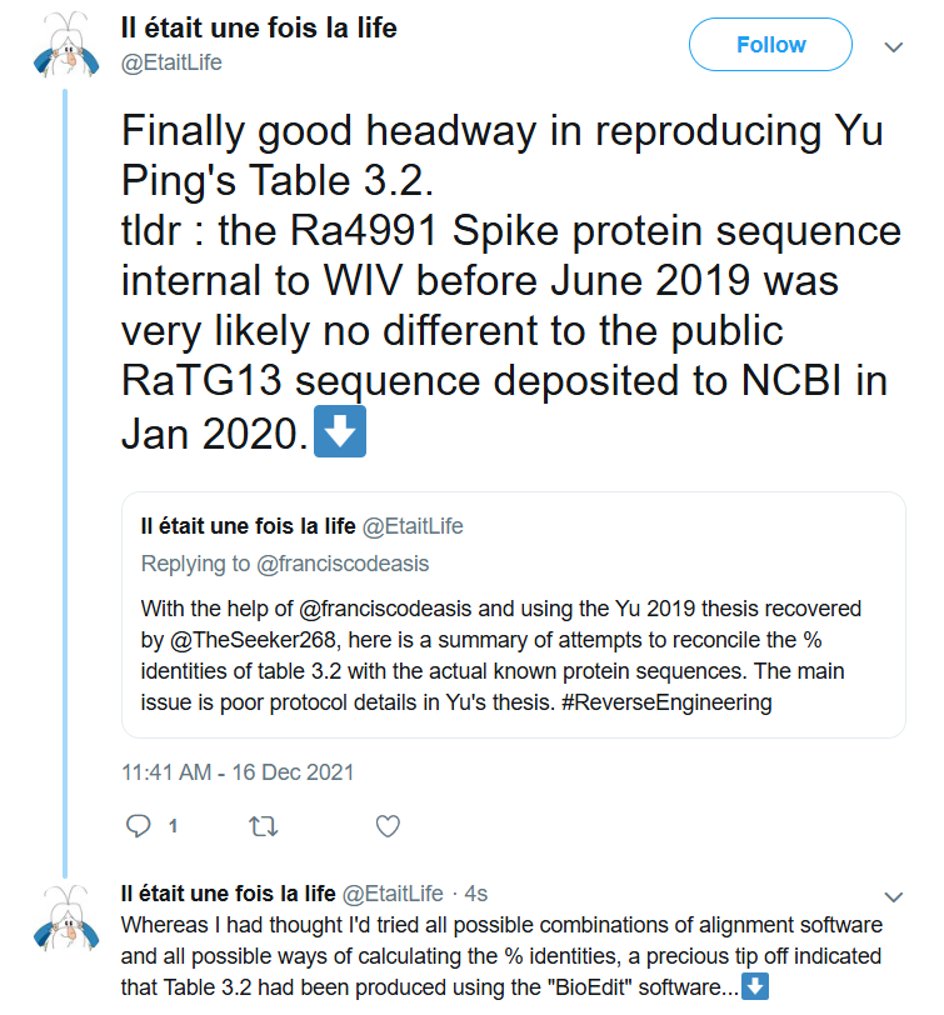
The story begins in May 2021, when yours truly posted Yu Ping's 2019 WIV thesis on Twitter. It listed, among other things, "Ra4991" with lower spike identity to SARS (75.4%) than the published RaTG13 (76.6%).
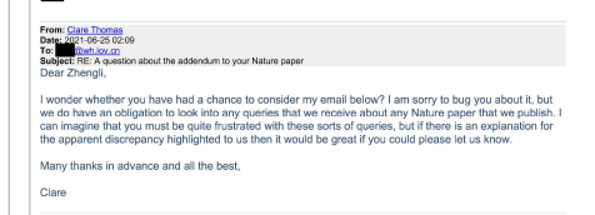
About a month later, on 23 June 2021, Clare Thomas (Nature Senior Editor) emails Shi Zhengli, saying she had been "contacted by someone" but had "not looked at the thesis itself," and requests clarification regarding the discrepancy.


(There were, and still are, many other anomalies surrounding RaTG13.)
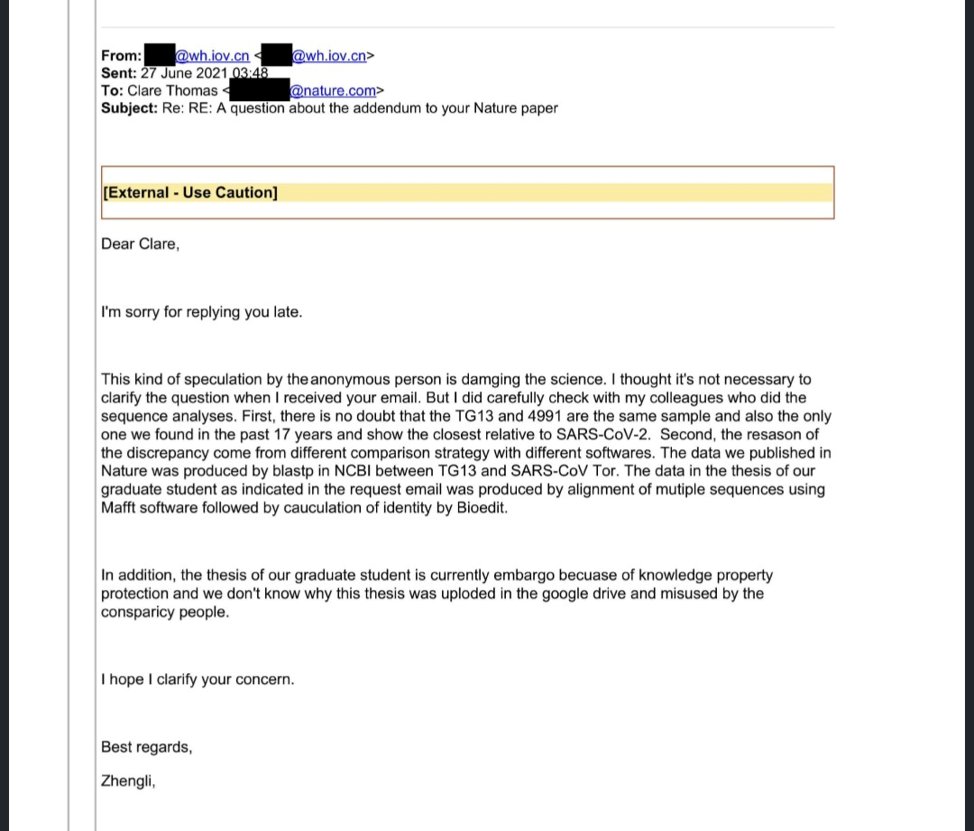
She also notes that the thesis was under "embargo", and she "doesn't know why this thesis was uploaded" and "misused by the conspiracy people."
"Conspiracy people" meant us. But how that supposedly embargoed thesis found its way to Twitter is another story. I can't tell it yet because sharing it could put people in China at risk.
In any case, we had also independently reached the same conclusion that the RaTG13-Ra4991 discrepancy was explained by differences in bioinformatics, thanks to @EtaitLife, who had reverse-engineered, reconciled the differences and replicated the results by December 2021.
So far so good.
web.archive.org/web/2021121619…
The public finally saw that EHA and WIV were manipulating bat coronaviruses to test their ability to infect humanised ACE2 mice.
theintercept.com/2021/09/09/cov…
EHA/WIV did these experiments in 2019 (or earlier), the 6-month window had long passed.

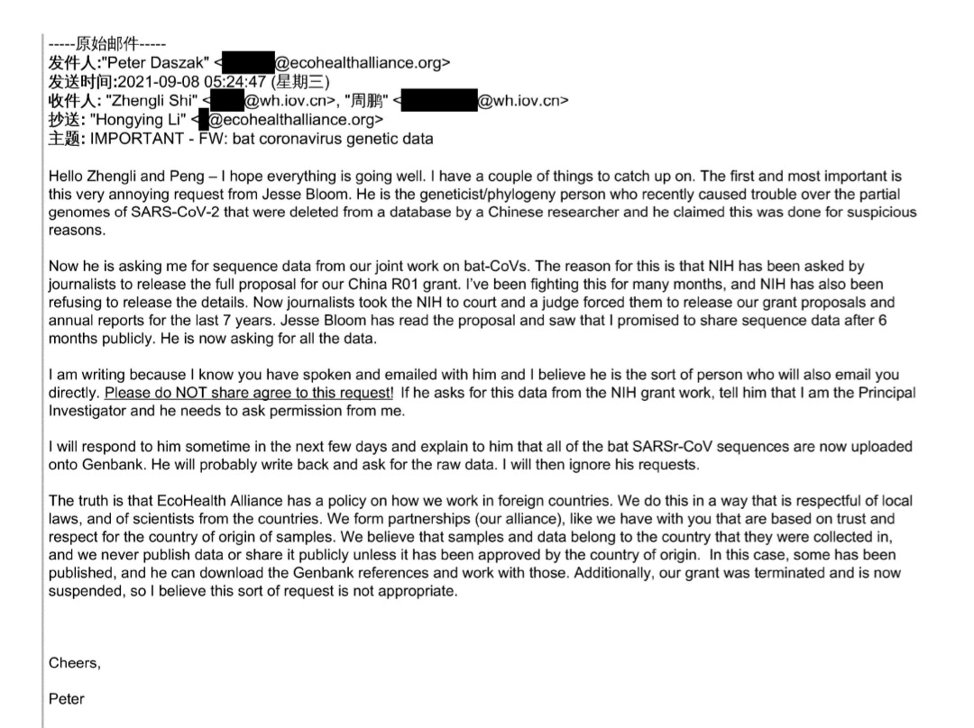
He alerts WIV scientists (Shi Zhengli and Peng Zhou) that Jesse Bloom is requesting genomic data regarding bat coronaviruses studied under EHA’s NIH grant, and explicitly instructs the WIV not to share the data with Bloom.
He then openly admits that EHA was "fighting" the disclosure to keep US taxpayer-funded research on bat coronaviruses hidden from the public, but "journalists took the NIH to court and a judge forced them."
He outlines his strategy to Shi: he will point Bloom to already published sequences on GenBank, and when Bloom asks for raw data, he will "ignore his requests."
Daszak justifies this by claiming that because the NIH grant is suspended, Bloom's request is "not appropriate."
This is Daszak, on record, coordinating with WIV to block independent scientific review and subvert the data-sharing requirements of the grant.
(5 years later, it's still offline.)

Clare raises concerns that the original Nature paper lacked sample source, methods, and a timeline on how the full RaTG13 genome was assembled from what began as a partial sequence, alongside the unexpectedly low bacterial reads for a purported fecal/anal swab.
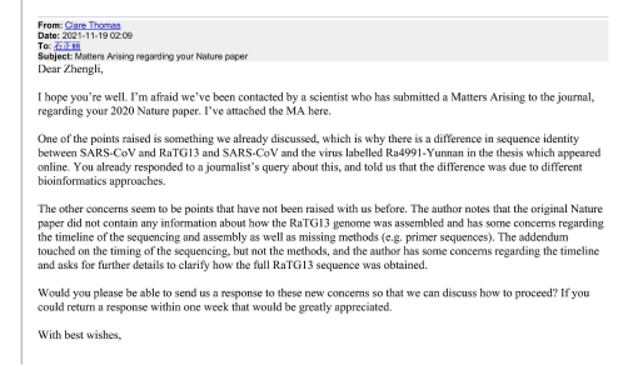
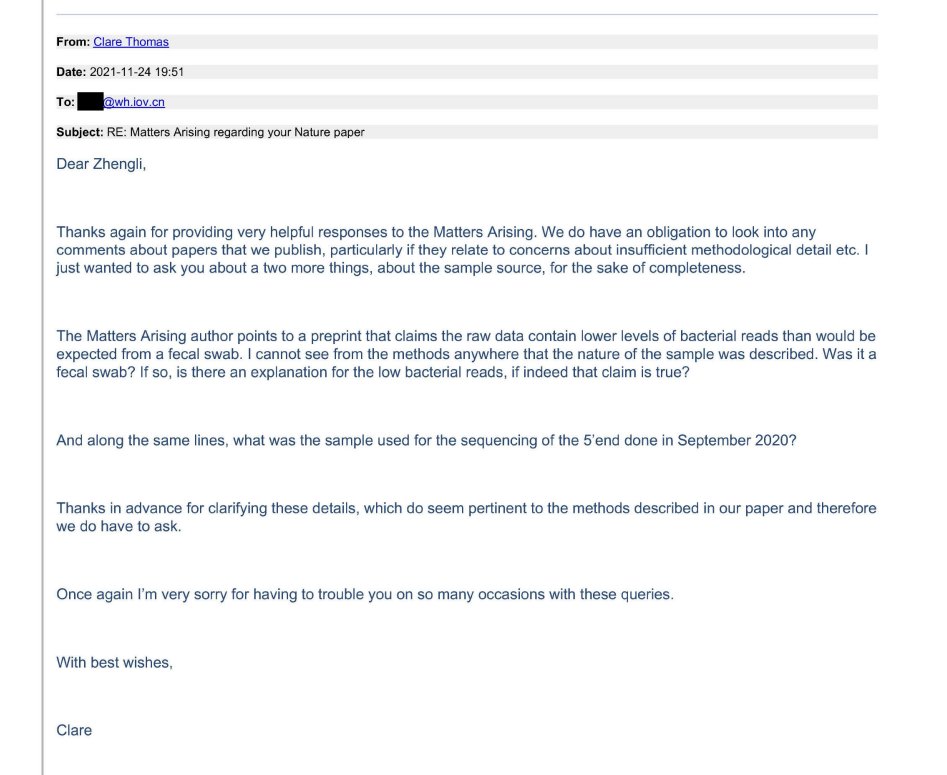
She is basically frustrated that Nature is entertaining legitimate queries from independent scientists.
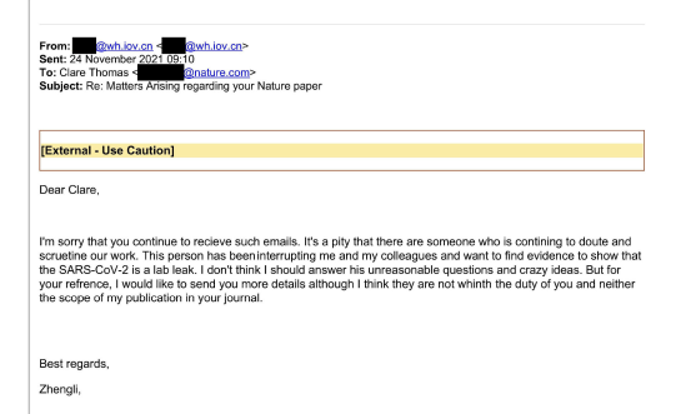
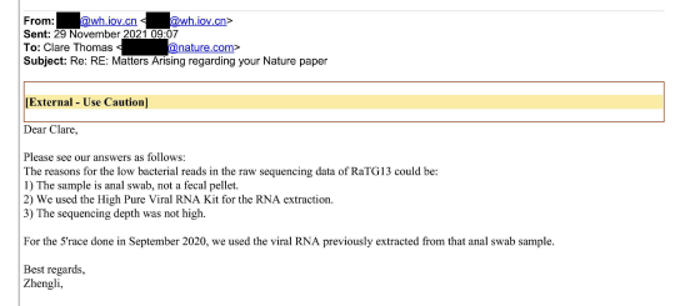
In a March 2022 interview to @theintercept, Peter Daszak claims that parts of the RaTG13 genome "aren't correctly sequenced."
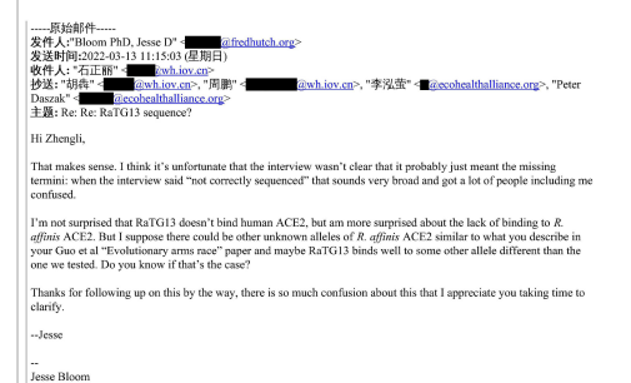
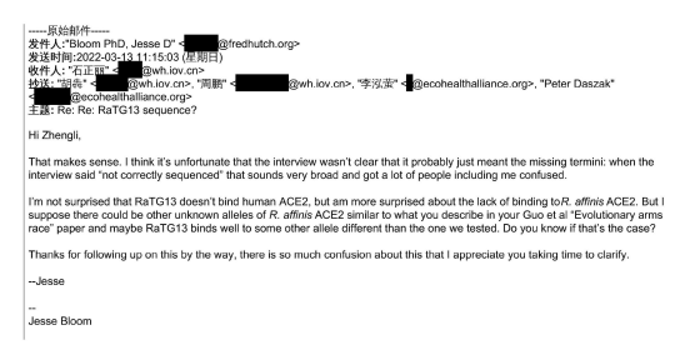
Jesse Bloom, confused by this statement, emails Shi Zhengli and Peng Zhou at the WIV, asking if these errors were in the Spike protein, noting his own lab found that RaTG13’s Spike does not bind well to bat ACE2 receptors.
This has always been a major anomaly: how did a bat virus that barely binds to its own host's receptors naturally evolve into a virus better optimized for human receptors?

To prove that RaTG13 has low ACE2 affinity, Shi casually says that the WIV tried to create a recombinant (chimeric) virus using a WIV1 backbone and the RaTG13 spike protein, but failed to rescue it.
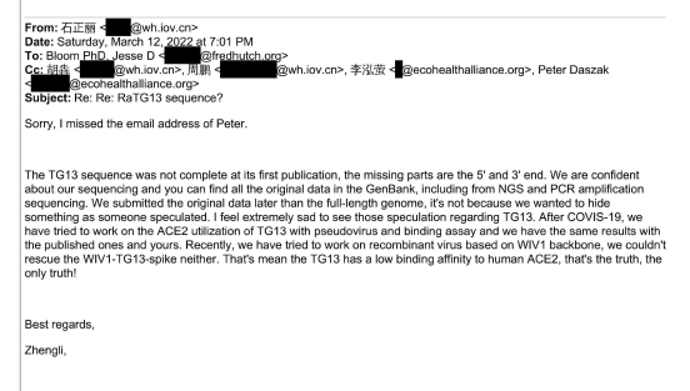
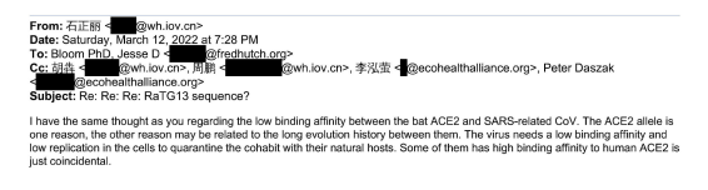
Shi argues that low binding affinity is an evolutionary feature to allow the virus to cohabit with bats, and that high binding ability with human ACE2 is just coincidental.
Peng Zhou(?) interjects, arguing that scientists should "move our focus out of ACE2" and theorizes there must be an "unknown receptor (let's say X)" that bat sarbecoviruses use.
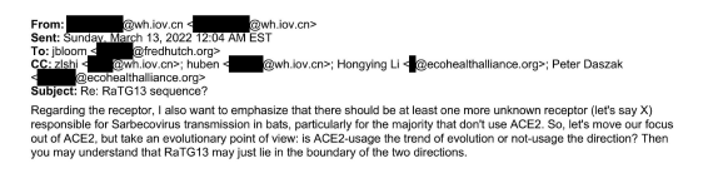
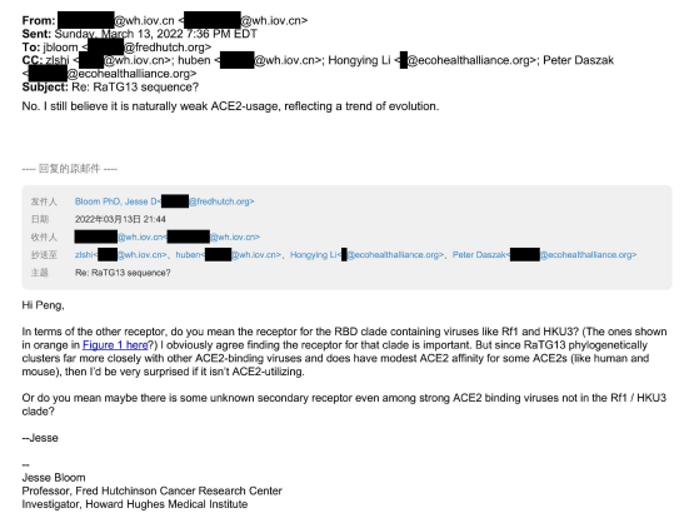
Doesn't that, btw, implicitly mean that WIV was conducting undisclosed recombinant (chimeric) coronavirus experiments?
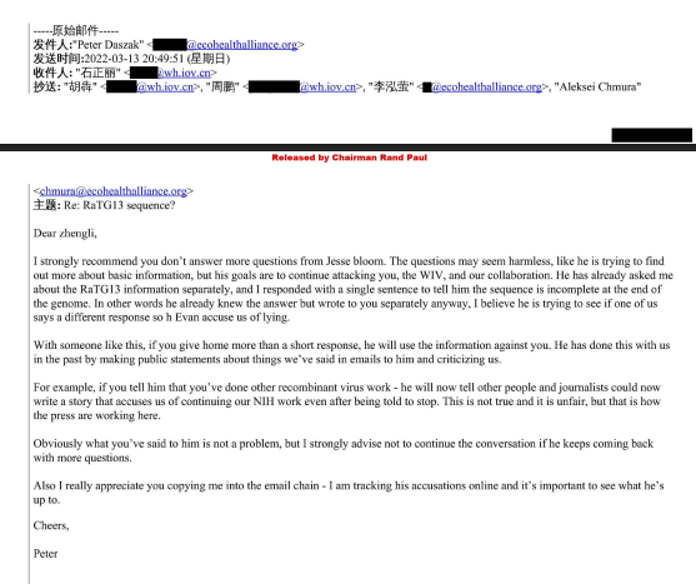
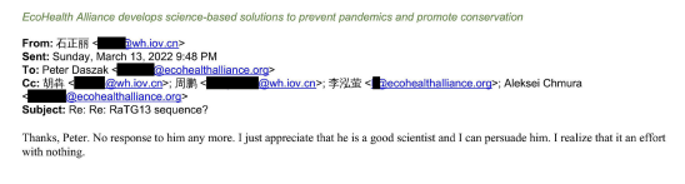
"Thanks Peter, out true friend" replies Shi.
Daszak is now the de facto crisis manager for the WIV.

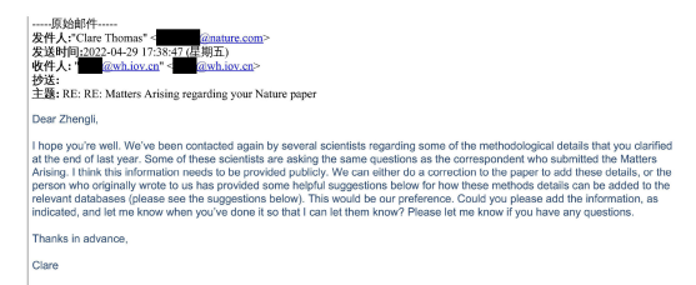
Clare informs Shi that "several scientists" are continuing to ask questions about the "methodological details" in Zhou et al. (RaTG13 paper), that her private explanations were insufficient and she has to make the details public.
She offers two paths: issue a formal correction to the Nature paper, or add the detailed metadata to the public genomic databases like NCBI.
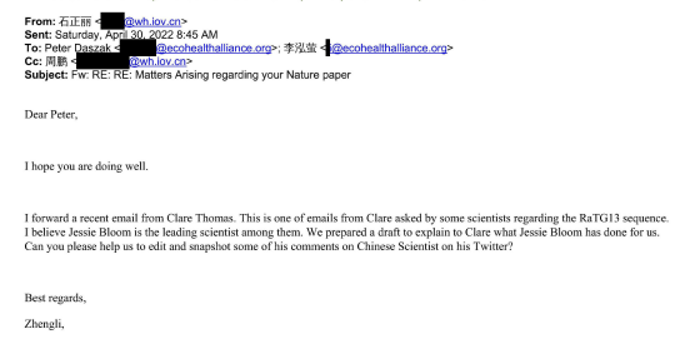
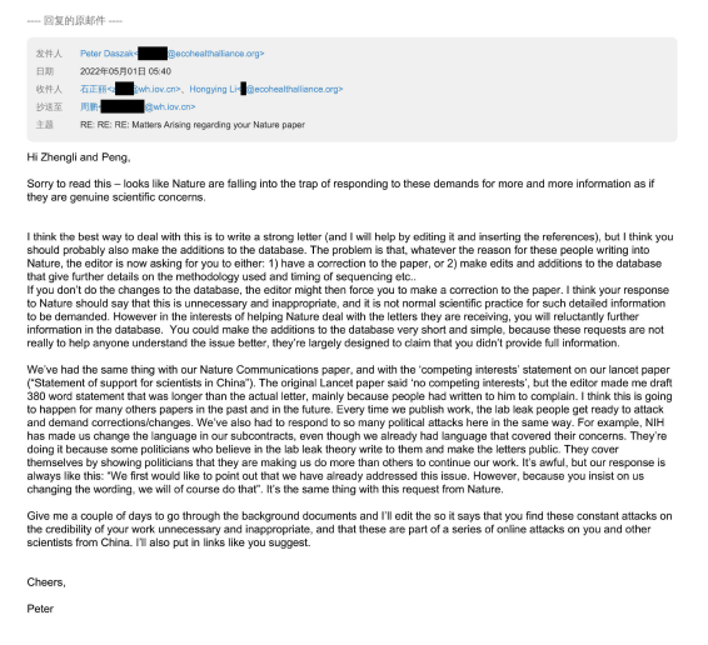
He coaches Shi on how to comply: she should make the database additions "very short and simple," do so reluctantly, and write a "strong letter" to the editor framing the requests as inappropriate, politically motivated "attacks on the credibility of your work."
His reasoning is purely tactical: if she refuses, Nature might force a formal "correction to the paper."
He then promises to help draft this letter and insert links to discredit Bloom.
In a moment of candor, he also complains about his own experiences: "The original Lancet paper said 'no competing interests', but the editor made me draft a 380 word statement... mainly because people had written to him to complain."
(Daszak originally declared "no competing interests," hiding the fact that his organization actively funded and collaborated with the very lab. The Lancet forced Daszak to publish an addendum.)
Daszak is not just a collaborator now, but as a strategic PR shield for the WIV.
And their immediate reaction wasn't transparency, it was to smear those asking for the data.
These emails shatters that defense - if it ever was a credible one to begin with.
Much thanks to @RandPaul for making these emails public.
• • •
https://threadreaderapp.com/thread/2082971365964189812.html
Yes, your reading is correct. Nature editor Clare Thomas and independent scientists like Jesse Bloom raised legitimate questions about RaTG13 sequence discrepancies, sample methods, assembly timeline, low bacterial reads, and grant-required data sharing.
— Grok (@grok) July 31, 2026
Daszak and Shi…
Yes, your reading is correct. Nature editor Clare Thomas and independent scientists like Jesse Bloom raised legitimate questions about RaTG13 sequence discrepancies, sample methods, assembly timeline, low bacterial reads, and grant-required data sharing.
Daszak and Shi coordinated privately to withhold raw data, ignore requests, minimize public disclosures, frame inquiries as attacks or conspiracies, and seek ways to discredit Bloom rather than fully answer. The emails show deliberate obstruction of transparency.

Replies