
My data matches this to the penny.
— Desi H-1Bhenchods (@desitechsuppoat) September 14, 2026
Basically, colleges blew the scope of CPT to mean any job, any kind of job even working as a housekeeper.
What it was supposed to do is train you directly on the career track that matches with your study. Going to college to learn about… https://t.co/s559tk6564
1/
A lot of Americans picture an “international student” as someone living on a campus.
That is only one model.
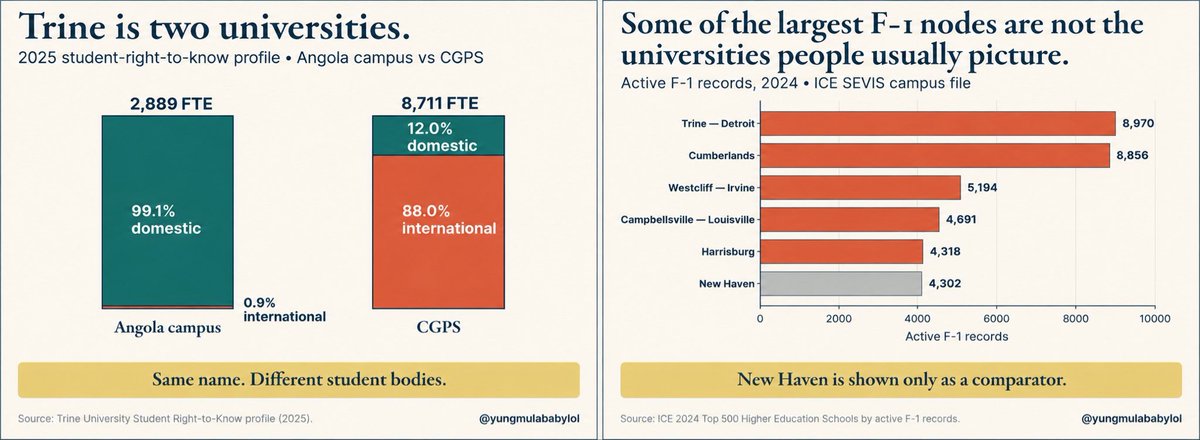
Trine’s Angola campus is 0.9% international.
Its graduate unit is 88% international and 3× the FTE.
Same name. Different student bodies.2/
Six schools in this set had 42,568 active F-1 records in 2024.
ICE’s CPT-employer table that year:
Amazon — 3,205
Tesla — 1,118
Lindsey Wilson College — 1,028
Google — 880
A Kentucky college employed more CPT students than Google.3/
Several of the biggest nodes were not founded this way.
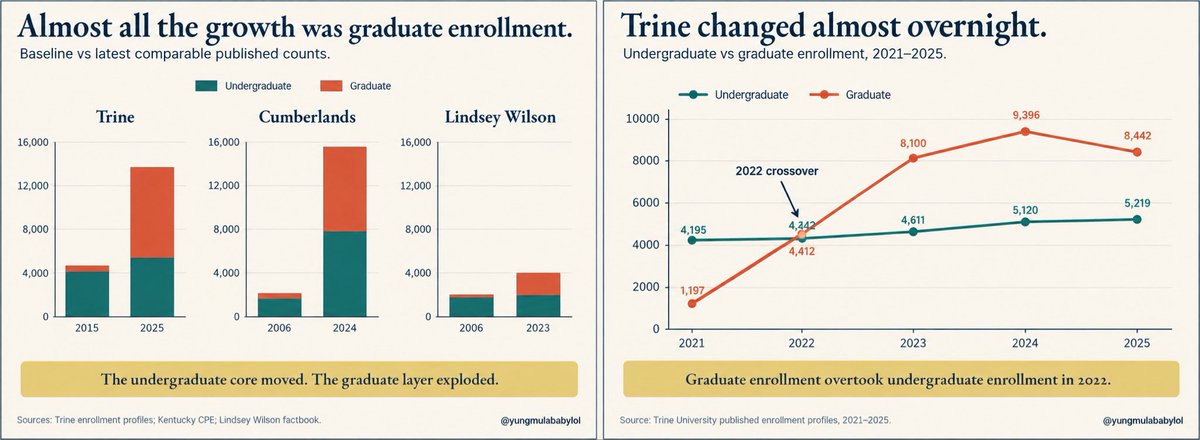
Ordinary regional colleges. Then the graduate layer exploded.
Trine graduate enrollment: 460 (2015) → 8,442 (2025)
Cumberlands: 359 (2006) → 14,508 (2024)
Lindsey Wilson graduate share: 11.8% → 55.1%
At Trine, graduate enrollment overtook undergraduate enrollment in 2022.4/
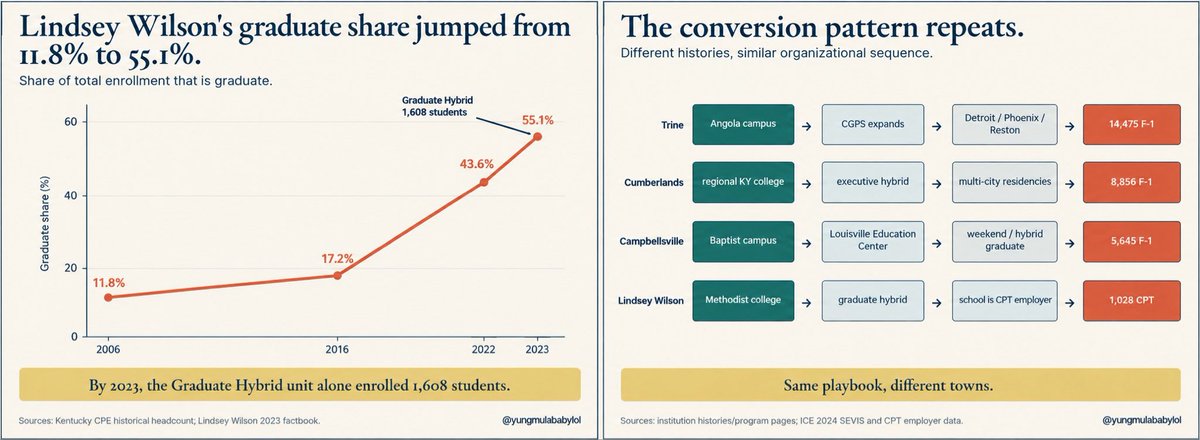
Lindsey Wilson’s graduate share went from 11.8% in 2006 to 55.1% in 2023.
The Graduate Hybrid unit alone was 1,608 students.
The sequence repeats:
old campus → executive/hybrid unit → satellite sites → large F-1 / CPT footprint
At Lindsey Wilson, the last step is the school itself as CPT employer.5/
Not one model.
Bucket 1: legacy colleges, pipeline bolted on later.
Trine, Cumberlands, Campbellsville, Lindsey Wilson.
Bucket 2: young STEM school, graduate-dominant early.
Harrisburg: 395 undergrad / 4,086 grad by 2016–17.6/
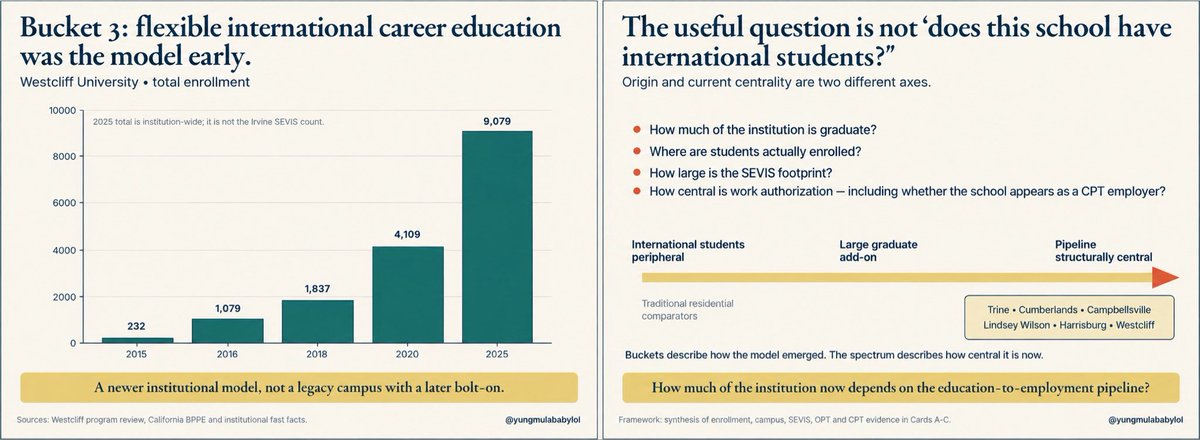
Bucket 3: newer flexible international career education model.
Westcliff: 232 students in 2015 → 9,079 in 2025.
“Does this school have international students?” is a weak test.
Better questions: how much of it is graduate, where those students sit, how large the SEVIS file is, and whether work authorization — including the school employing its own CPT students — is central.
Buckets describe origin.
The spectrum describes how central the pipeline is now.7/
The broader map breaks into three institutional types. The buckets describe 𝐡𝐨𝐰 𝐭𝐡𝐞 𝐢𝐧𝐬𝐭𝐢𝐭𝐮𝐭𝐢𝐨𝐧 𝐠𝐨𝐭 𝐡𝐞𝐫𝐞, not whether every program at the school operates the same way.
𝐁𝐔𝐂𝐊𝐄𝐓 𝟏 — 𝐋𝐞𝐠𝐚𝐜𝐲 𝐜𝐨𝐥𝐥𝐞𝐠𝐞𝐬 𝐰𝐢𝐭𝐡 𝐚 𝐩𝐢𝐩𝐞𝐥𝐢𝐧𝐞 𝐚𝐝𝐝𝐞𝐝 𝐥𝐚𝐭𝐞𝐫
Core examples: Trine University; University of the Cumberlands; Campbellsville University; Lindsey Wilson.
Same broad pattern: New England College; Monroe University; Ottawa University; Texas Wesleyan; Benedictine University; Indiana Wesleyan; National Louis University; Golden Gate University; Cumberland University (Tennessee — not Cumberlands); Webster University; McDaniel College; St. Francis College; Curry College; Avila University; Tennessee Wesleyan; North Carolina Wesleyan; Dallas Baptist University; Faulkner University; Lindenwood University; Concordia University Texas.
Some still have substantial conventional domestic cores. The pipeline can be a unit inside an older university rather than the whole institution.
𝐁𝐔𝐂𝐊𝐄𝐓 𝟐 — 𝐘𝐨𝐮𝐧𝐠𝐞𝐫 𝐢𝐧𝐬𝐭𝐢𝐭𝐮𝐭𝐢𝐨𝐧𝐬 𝐰𝐡𝐞𝐫𝐞 𝐭𝐡𝐞 𝐩𝐢𝐩𝐞𝐥𝐢𝐧𝐞 𝐛𝐞𝐜𝐚𝐦𝐞 𝐜𝐞𝐧𝐭𝐫𝐚𝐥 𝐞𝐚𝐫𝐥𝐲
Harrisburg University of Science & Technology is the clearest case in this set. It was founded as a regional STEM institution, but graduate/international enrollment became dominant while the university itself was still young.
𝐁𝐔𝐂𝐊𝐄𝐓 𝟑 — 𝐅𝐥𝐞𝐱𝐢𝐛𝐥𝐞 / 𝐜𝐚𝐫𝐞𝐞𝐫-𝐨𝐫𝐢𝐞𝐧𝐭𝐞𝐝 𝐢𝐧𝐬𝐭𝐢𝐭𝐮𝐭𝐢𝐨𝐧𝐬 𝐬𝐭𝐫𝐮𝐜𝐭𝐮𝐫𝐚𝐥𝐥𝐲 𝐜𝐨𝐦𝐩𝐚𝐭𝐢𝐛𝐥𝐞 𝐰𝐢𝐭𝐡 𝐭𝐡𝐞 𝐦𝐨𝐝𝐞𝐥 𝐞𝐚𝐫𝐥𝐲
Westcliff University; California Institute of Advanced Management (CIAM); University of the Potomac; Washington University of Science and Technology (not WashU); Bay Atlantic University; California Miramar University; Hellenic American University; Sofia University; Humphreys University.
Sullivan University and Goldey-Beacom College sit closer to this category than the simple legacy-conversion story, but the boundary is less clean.
𝐀𝐃𝐉𝐀𝐂𝐄𝐍𝐓 — 𝐬𝐚𝐦𝐞 𝐥𝐚𝐛𝐨𝐫-𝐦𝐚𝐫𝐤𝐞𝐭 𝐟𝐮𝐧𝐜𝐭𝐢𝐨𝐧, 𝐧𝐨𝐭 𝐧𝐞𝐜𝐞𝐬𝐬𝐚𝐫𝐢𝐥𝐲 𝐃𝐚𝐲-𝟏 𝐂𝐏𝐓 𝐛𝐫𝐚𝐧𝐝𝐞𝐝
University of New Haven; Sacred Heart University; Southern Arkansas University; Northwest Missouri State; University of Central Missouri / Missouri Innovation Campus; UT Arlington; University of North Texas.
These are large international master’s / OPT pipelines and should not simply be collapsed into the Day-1 CPT category.
NYU, Columbia, Northeastern, USC, etc. also should not be lumped into this map merely because they enroll large numbers of international master’s students. That is a different institutional model.
The useful distinction is:
𝐃𝐢𝐝 𝐚𝐧 𝐨𝐥𝐝 𝐜𝐨𝐥𝐥𝐞𝐠𝐞 𝐚𝐝𝐝 𝐚 𝐩𝐢𝐩𝐞𝐥𝐢𝐧𝐞?
𝐃𝐢𝐝 𝐢𝐭 𝐛𝐞𝐜𝐨𝐦𝐞 𝐜𝐞𝐧𝐭𝐫𝐚𝐥 𝐰𝐡𝐢𝐥𝐞 𝐚 𝐲𝐨𝐮𝐧𝐠 𝐢𝐧𝐬𝐭𝐢𝐭𝐮𝐭𝐢𝐨𝐧 𝐰𝐚𝐬 𝐟𝐨𝐫𝐦𝐢𝐧𝐠?
𝐎𝐫 𝐰𝐚𝐬 𝐟𝐥𝐞𝐱𝐢𝐛𝐥𝐞 𝐢𝐧𝐭𝐞𝐫𝐧𝐚𝐭𝐢𝐨𝐧𝐚𝐥 𝐜𝐚𝐫𝐞𝐞𝐫 𝐞𝐝𝐮𝐜𝐚𝐭𝐢𝐨𝐧 𝐬𝐭𝐫𝐮𝐜𝐭𝐮𝐫𝐚𝐥𝐥𝐲 𝐩𝐚𝐫𝐭 𝐨𝐟 𝐭𝐡𝐞 𝐦𝐨𝐝𝐞𝐥 𝐞𝐚𝐫𝐥𝐲?
Then ask how much of the institution it actually represents.8/
𝐓𝐡𝐞 𝐬𝐦𝐚𝐥𝐥𝐞𝐫 𝐃𝐚𝐲-𝟏 𝐂𝐏𝐓 𝐬𝐜𝐡𝐨𝐨𝐥𝐬 𝐝𝐢𝐬𝐜𝐮𝐬𝐬𝐞𝐝 𝐚𝐛𝐨𝐯𝐞 𝐚𝐫𝐞 𝐚𝐜𝐜𝐫𝐞𝐝𝐢𝐭𝐞𝐝 𝐢𝐧𝐬𝐭𝐢𝐭𝐮𝐭𝐢𝐨𝐧𝐬 — 𝐧𝐨𝐭 𝐜𝐥𝐚𝐬𝐬𝐢𝐜 𝐮𝐧𝐚𝐜𝐜𝐫𝐞𝐝𝐢𝐭𝐞𝐝 𝐝𝐢𝐩𝐥𝐨𝐦𝐚 𝐦𝐢𝐥𝐥𝐬.
But for a substantial share of their international/hybrid graduate programs, the available reporting looks much more like an 𝐞𝐝𝐮𝐜𝐚𝐭𝐢𝐨𝐧-𝐭𝐨-𝐰𝐨𝐫𝐤-𝐚𝐮𝐭𝐡𝐨𝐫𝐢𝐳𝐚𝐭𝐢𝐨𝐧 𝐩𝐢𝐩𝐞𝐥𝐢𝐧𝐞 than the residential-college model most people imagine.
Bloomberg’s 2024 investigation of Harrisburg found that 𝐦𝐨𝐫𝐞 𝐭𝐡𝐚𝐧 𝐡𝐚𝐥𝐟 of an early international cohort left after winning the H-1B lottery, while 𝐟𝐞𝐰𝐞𝐫 𝐭𝐡𝐚𝐧 𝐨𝐧𝐞 𝐢𝐧 𝐭𝐡𝐫𝐞𝐞 stayed through graduation.
Many already had jobs. Bloomberg described the arrangement, for many participants, as an “elaborate charade” for remaining in the country legally.
Westcliff’s California filings point in the same direction. LayoffHedge’s analysis found that one residential DBA cohort of 𝟑𝟕𝟓 students produced 𝐳𝐞𝐫𝐨 on-time graduates and only 𝟔 degrees awarded in the reporting year.
Across multiple years, the residential graduate track finished at much lower rates than the online track.
That distinction matters because the residential/hybrid track is the one tied to F-1 status and CPT eligibility.
The incentive structure is straightforward: remain enrolled, maintain F-1 status, keep working through CPT, and stay in the H-1B lottery or pursue another status option.
A 2026 DHS rule now limits part of the same strategy by ending open-ended duration-of-status treatment and prospectively restricting same- or lower-level repeat enrollment after completing a U.S. program.
None of this means every student is fake or every degree is worthless. Some students graduate, and the schools are accredited.
But the pattern is difficult to miss:
𝐅𝐨𝐫 𝐚 𝐥𝐚𝐫𝐠𝐞 𝐩𝐚𝐫𝐭 𝐨𝐟 𝐭𝐡𝐞 𝐞𝐧𝐫𝐨𝐥𝐥𝐦𝐞𝐧𝐭 𝐛𝐨𝐨𝐦, 𝐮𝐧𝐢𝐧𝐭𝐞𝐫𝐫𝐮𝐩𝐭𝐞𝐝 𝐰𝐨𝐫𝐤 𝐚𝐮𝐭𝐡𝐨𝐫𝐢𝐳𝐚𝐭𝐢𝐨𝐧 𝐚𝐩𝐩𝐞𝐚𝐫𝐬 𝐭𝐨 𝐛𝐞 𝐭𝐡𝐞 𝐭𝐡𝐢𝐧𝐠 𝐬𝐭𝐮𝐝𝐞𝐧𝐭𝐬 𝐯𝐚𝐥𝐮𝐞 𝐦𝐨𝐬𝐭, 𝐰𝐡𝐢𝐥𝐞 𝐟𝐢𝐧𝐢𝐬𝐡𝐢𝐧𝐠 𝐭𝐡𝐞 𝐝𝐞𝐠𝐫𝐞𝐞 𝐢𝐬 𝐨𝐟𝐭𝐞𝐧 𝐬𝐞𝐜𝐨𝐧𝐝𝐚𝐫𝐲.9/
Large universities run a related pipeline, 𝐧𝐨𝐭 𝐭𝐡𝐞 𝐬𝐚𝐦𝐞 𝐩𝐫𝐨𝐝𝐮𝐜𝐭.
The Day-1 CPT model — hybrid master’s, work authorized from the beginning, minimal campus time, recruiter-driven enrollment — is concentrated in the smaller schools discussed above.
NYU, Columbia, Northeastern, USC, ASU, Illinois, Purdue, Michigan and the major Texas publics generally do not sell that package.
Students there usually attend conventional degree programs. Northeastern’s CPT-heavy co-op model, for example, is a longstanding academic design used by domestic students too.
𝐁𝐮𝐭 𝐭𝐡𝐞 𝐥𝐚𝐫𝐠𝐞-𝐮𝐧𝐢𝐯𝐞𝐫𝐬𝐢𝐭𝐲 𝐩𝐢𝐩𝐞𝐥𝐢𝐧𝐞 𝐢𝐬𝐧’𝐭 𝐣𝐮𝐬𝐭 “𝐬𝐜𝐡𝐨𝐨𝐥, 𝐭𝐡𝐞𝐧 𝐚 𝐣𝐨𝐛” 𝐞𝐢𝐭𝐡𝐞𝐫.
F-1 graduates can receive 𝟏𝟐 𝐦𝐨𝐧𝐭𝐡𝐬 𝐨𝐟 𝐎𝐏𝐓. A qualifying STEM degree adds another 𝟐𝟒 months.
That means up to 𝟑 𝐲𝐞𝐚𝐫𝐬 𝐨𝐟 𝐔.𝐒. 𝐞𝐦𝐩𝐥𝐨𝐲𝐦𝐞𝐧𝐭 𝐢𝐧 𝐅-𝟏 𝐬𝐭𝐚𝐭𝐮𝐬 before H-1B.
There can also be a labor-cost difference.
F-1 workers who are still nonresident aliens for tax purposes are generally exempt from Social Security and Medicare taxes on authorized OPT/STEM-OPT employment. The employer also avoids its matching FICA contribution.
𝐅𝐨𝐫 𝐰𝐚𝐠𝐞𝐬 𝐛𝐞𝐥𝐨𝐰 𝐭𝐡𝐞 𝐒𝐨𝐜𝐢𝐚𝐥 𝐒𝐞𝐜𝐮𝐫𝐢𝐭𝐲 𝐰𝐚𝐠𝐞 𝐛𝐚𝐬𝐞, 𝐭𝐡𝐚𝐭 𝐜𝐚𝐧 𝐦𝐞𝐚𝐧 𝐮𝐩 𝐭𝐨 𝟕.𝟔𝟓% 𝐥𝐞𝐬𝐬 𝐞𝐦𝐩𝐥𝐨𝐲𝐞𝐫 𝐩𝐚𝐲𝐫𝐨𝐥𝐥 𝐭𝐚𝐱 than for a citizen or green-card holder.
The exemption is temporary, but while it applies the labor-market comparison is not cost-neutral.
Then there is STEM designation itself.
𝐒𝐓𝐄𝐌 𝐎𝐏𝐓 𝐢𝐬 𝐧𝐨𝐭 𝐬𝐢𝐦𝐩𝐥𝐲 “𝐲𝐨𝐮 𝐬𝐭𝐮𝐝𝐢𝐞𝐝 𝐬𝐜𝐢𝐞𝐧𝐜𝐞.”
It depends on the CIP code assigned to the degree and whether that code appears on DHS’s STEM list.
Beyond core engineering, biology, math and physical science, the list now includes Business Analytics, Financial Analytics, Data Analytics, I-O Psychology, Landscape Architecture, Institutional Research and Environmental/Natural Resource Economics.
After the 2023 update, DHS received 𝟏𝟑𝟑 nominations covering 68 fields for addition — and 𝐳𝐞𝐫𝐨 for removal.
That changes the product:
𝐧𝐨𝐧-𝐒𝐓𝐄𝐌 → 𝟏𝟐 𝐦𝐨𝐧𝐭𝐡𝐬 𝐎𝐏𝐓
𝐒𝐓𝐄𝐌 → 𝐮𝐩 𝐭𝐨 𝟑𝟔 𝐦𝐨𝐧𝐭𝐡𝐬
So a CIP classification can add 𝐭𝐰𝐨 𝐲𝐞𝐚𝐫𝐬 𝐨𝐟 𝐔.𝐒. 𝐰𝐨𝐫𝐤 𝐚𝐮𝐭𝐡𝐨𝐫𝐢𝐳𝐚𝐭𝐢𝐨𝐧.
The degree can be legitimate and rigorous. The immigration value of its classification is still part of the product.10/
And this is increasingly a master’s-level system.
In ICE’s 2024 data, master’s students were roughly 𝟒𝟔.𝟓% 𝐨𝐟 𝐟𝐨𝐫𝐞𝐢𝐠𝐧 𝐬𝐭𝐮𝐝𝐞𝐧𝐭 𝐫𝐞𝐜𝐨𝐫𝐝𝐬 𝐢𝐧 𝐔.𝐒. 𝐡𝐢𝐠𝐡𝐞𝐫 𝐞𝐝𝐮𝐜𝐚𝐭𝐢𝐨𝐧 — larger than the bachelor’s share.
A famous university can have an extremely selective undergraduate college while operating much larger professional master’s programs with very different admissions economics.
UNT and UT Arlington are useful boundary cases: huge international graduate populations and huge OPT footprints, without being Day-1 CPT schools.
There is another immigration advantage after graduation.
A qualifying U.S. master’s degree gives access to the separate 𝟐𝟎,𝟎𝟎𝟎-𝐩𝐞𝐫-𝐲𝐞𝐚𝐫 𝐇-𝟏𝐁 𝐚𝐝𝐯𝐚𝐧𝐜𝐞𝐝-𝐝𝐞𝐠𝐫𝐞𝐞 𝐞𝐱𝐞𝐦𝐩𝐭𝐢𝐨𝐧.
So the degree can carry both:
𝐚 𝐥𝐨𝐧𝐠𝐞𝐫 𝐎𝐏𝐓 𝐫𝐮𝐧𝐰𝐚𝐲
+
𝐚𝐧 𝐚𝐝𝐝𝐢𝐭𝐢𝐨𝐧𝐚𝐥 𝐇-𝟏𝐁 𝐬𝐞𝐥𝐞𝐜𝐭𝐢𝐨𝐧 𝐨𝐩𝐩𝐨𝐫𝐭𝐮𝐧𝐢𝐭𝐲.
That produces two genuinely different products:
𝐃𝐚𝐲-𝟏 𝐂𝐏𝐓:
𝐰𝐨𝐫𝐤 𝐟𝐢𝐫𝐬𝐭 → 𝐡𝐲𝐛𝐫𝐢𝐝 𝐦𝐚𝐬𝐭𝐞𝐫’𝐬 → 𝐂𝐏𝐓 → 𝐎𝐏𝐓 → 𝐇-𝟏𝐁
𝐂𝐨𝐧𝐯𝐞𝐧𝐭𝐢𝐨𝐧𝐚𝐥 𝐮𝐧𝐢𝐯𝐞𝐫𝐬𝐢𝐭𝐲:
𝐦𝐚𝐬𝐭𝐞𝐫’𝐬 → 𝐎𝐏𝐓 / 𝐒𝐓𝐄𝐌 𝐎𝐏𝐓 → 𝐇-𝟏𝐁
A Purdue or Columbia graduate who attended classes and earned a real degree is 𝐧𝐨𝐭 equivalent to someone enrolling at a satellite center principally to maintain work authorization.
But “meritocratic” still flattens three different questions:
𝟏. 𝐀𝐜𝐚𝐝𝐞𝐦𝐢𝐜 𝐦𝐞𝐫𝐢𝐭 — did the student actually earn the degree?
𝟐. 𝐀𝐝𝐦𝐢𝐬𝐬𝐢𝐨𝐧𝐬 — how selective is that particular master’s program, rather than the university brand generally?
𝟑. 𝐋𝐚𝐛𝐨𝐫-𝐦𝐚𝐫𝐤𝐞𝐭 𝐫𝐮𝐥𝐞𝐬 — OPT length, STEM-CIP status, payroll-tax treatment and the H-1B master’s-cap advantage.
A student can be talented and legitimately earn a difficult degree 𝐚𝐧𝐝 still enter a labor market whose rules give that degree immigration and employment value beyond the education itself.
𝐒𝐚𝐦𝐞 𝐥𝐚𝐛𝐨𝐫-𝐦𝐚𝐫𝐤𝐞𝐭 𝐞𝐱𝐢𝐭.
𝐃𝐢𝐟𝐟𝐞𝐫𝐞𝐧𝐭 𝐚𝐜𝐚𝐝𝐞𝐦𝐢𝐜 𝐩𝐫𝐨𝐝𝐮𝐜𝐭.
𝐁𝐮𝐭 𝐭𝐡𝐞 𝐢𝐦𝐦𝐢𝐠𝐫𝐚𝐭𝐢𝐨𝐧 𝐯𝐚𝐥𝐮𝐞 𝐨𝐟 𝐭𝐡𝐞 𝐝𝐞𝐠𝐫𝐞𝐞 𝐢𝐬 𝐫𝐞𝐚𝐥 𝐢𝐧 𝐛𝐨𝐭𝐡.11/
The educational products differ. 𝐓𝐡𝐞 𝐥𝐚𝐛𝐨𝐫-𝐦𝐚𝐫𝐤𝐞𝐭 𝐞𝐱𝐢𝐭 𝐜𝐨𝐧𝐯𝐞𝐫𝐠𝐞𝐬.
The same companies sit near the top of 𝐂𝐏𝐓, 𝐎𝐏𝐓/𝐒𝐓𝐄𝐌-𝐎𝐏𝐓, 𝐚𝐧𝐝 𝐇-𝟏𝐁 hiring.
ICE 2024:
Amazon — 𝟑,𝟐𝟎𝟓 CPT / 𝟏𝟎,𝟏𝟔𝟕 OPT+STEM OPT
Google — 𝟖𝟖𝟎 / 𝟐,𝟒𝟓𝟒
Microsoft — 𝟖𝟏𝟗 / 𝟐,𝟏𝟒𝟑
Meta — 𝟔𝟓𝟕 / 𝟐,𝟎𝟑𝟐
Tesla — 𝟏,𝟏𝟏𝟖 / 𝟏,𝟓𝟒𝟖
Then comes H-1B.
In FY2025, senators Grassley and Durbin cited approved H-1B hiring of:
Amazon — 𝟏𝟎,𝟎𝟒𝟒
Microsoft — 𝟓,𝟏𝟖𝟗
Meta — 𝟓,𝟏𝟐𝟑
Google — 𝟒,𝟏𝟖𝟏
The same senators asked these firms why they were filing thousands of H-1B petitions while conducting large layoffs of American workers.
The two education routes increasingly converge here:
𝐃𝐚𝐲-𝟏 𝐂𝐏𝐓 → 𝐎𝐏𝐓 / 𝐒𝐓𝐄𝐌 𝐎𝐏𝐓 → 𝐇-𝟏𝐁
𝐂𝐨𝐧𝐯𝐞𝐧𝐭𝐢𝐨𝐧𝐚𝐥 𝐦𝐚𝐬𝐭𝐞𝐫’𝐬 → 𝐎𝐏𝐓 / 𝐒𝐓𝐄𝐌 𝐎𝐏𝐓 → 𝐇-𝟏𝐁
From the employer’s side, that can mean an already-trained, already-vetted worker who is already in the U.S.
From the American worker’s side, it can look like the same company is cutting domestic employees while maintaining a parallel foreign-worker pipeline into similar technical labor markets.
That does 𝐧𝐨𝐭 prove every H-1B hire replaced a laid-off American worker. Jobs, locations, timing and specialties can differ.
But the conflict is real enough that two senior senators — one Republican, one Democrat — formally asked the companies to explain it.
𝐁𝐨𝐭𝐡 𝐭𝐡𝐢𝐧𝐠𝐬 𝐜𝐚𝐧 𝐛𝐞 𝐭𝐫𝐮𝐞: companies can legally need specialized foreign talent, while the structure also gives them a ready labor pool whose ability to remain working in the U.S. depends on maintaining qualifying immigration status.
𝐓𝐡𝐚𝐭 𝐢𝐬 𝐰𝐡𝐲 𝐦𝐚𝐧𝐲 𝐀𝐦𝐞𝐫𝐢𝐜𝐚𝐧𝐬 𝐰𝐨𝐮𝐥𝐝 𝐬𝐞𝐞 𝐭𝐡𝐞 𝐜𝐨𝐦𝐛𝐢𝐧𝐚𝐭𝐢𝐨𝐧 — 𝐥𝐚𝐲𝐨𝐟𝐟𝐬 + 𝐂𝐏𝐓/𝐎𝐏𝐓 𝐡𝐢𝐫𝐢𝐧𝐠 + 𝐧𝐞𝐰 𝐇-𝟏𝐁 𝐬𝐩𝐨𝐧𝐬𝐨𝐫𝐬𝐡𝐢𝐩 — 𝐚𝐬 𝐚 𝐬𝐭𝐫𝐮𝐜𝐭𝐮𝐫𝐚𝐥 𝐜𝐨𝐧𝐟𝐥𝐢𝐜𝐭, 𝐧𝐨𝐭 𝐭𝐡𝐫𝐞𝐞 𝐮𝐧𝐫𝐞𝐥𝐚𝐭𝐞𝐝 𝐩𝐞𝐫𝐬𝐨𝐧𝐧𝐞𝐥 𝐝𝐞𝐜𝐢𝐬𝐢𝐨𝐧𝐬.12/
There is another layer between the school and the household-name employer:
𝐭𝐡𝐞 𝐈𝐓 𝐬𝐭𝐚𝐟𝐟𝐢𝐧𝐠 / 𝐨𝐮𝐭𝐬𝐨𝐮𝐫𝐜𝐢𝐧𝐠 𝐟𝐢𝐫𝐦.
A worker can perform services at a major bank or tech company while technically being employed and sponsored by Cognizant, Infosys, TCS, Wipro, HCL or another vendor.
USCIS explicitly recognizes this structure: the H-1B petitioner can place a worker at a third-party end-client, sometimes through multiple intermediary vendors.
So:
𝐰𝐨𝐫𝐤𝐬 𝐚𝐭 𝐆𝐨𝐨𝐠𝐥𝐞
does not necessarily mean
𝐆𝐨𝐨𝐠𝐥𝐞 𝐞𝐦𝐩𝐥𝐨𝐲𝐬 𝐨𝐫 𝐬𝐩𝐨𝐧𝐬𝐨𝐫𝐬 𝐭𝐡𝐚𝐭 𝐰𝐨𝐫𝐤𝐞𝐫.
And the staffing firms are themselves large participants in the student-work pipeline.
ICE’s 2024 OPT/STEM-OPT employer table lists, among others:
Tata Consultancy Services — 𝟖𝟓𝟏
Infosys — 𝟕𝟖𝟖
alongside hundreds of students at smaller staffing and consulting firms.
At H-1B scale, the outsourcing model is even more important.
Bloomberg found that Cognizant’s internal planning documents projected needing fewer than 4,000 new H-1B workers but recommended filing for almost 𝐭𝐡𝐫𝐞𝐞 𝐭𝐢𝐦𝐞𝐬 𝐭𝐡𝐚𝐭 𝐧𝐮𝐦𝐛𝐞𝐫 because management assumed only about 30% would be selected in the lottery.
Cognizant said each registration represented a legitimate job offer and said the company ultimately filed fewer petitions than the planning document proposed.
That is a different business model from Amazon directly hiring a Stanford graduate.
𝐓𝐡𝐞 𝐨𝐮𝐭𝐬𝐨𝐮𝐫𝐜𝐞𝐫’𝐬 𝐩𝐫𝐨𝐝𝐮𝐜𝐭 𝐢𝐬 𝐥𝐚𝐛𝐨𝐫 𝐢𝐭𝐬𝐞𝐥𝐟.
It recruits or sponsors the worker, holds the employment relationship, and supplies that worker to a client.
The smaller consultancy layer can be much uglier.
DOL has repeatedly brought cases against IT staffing firms for illegally “benching” H-1B workers — leaving them without assignments and failing to pay the required wage — as well as underpaying workers relative to their LCAs.
So the full structure can be:
𝐬𝐜𝐡𝐨𝐨𝐥 → 𝐂𝐏𝐓 / 𝐎𝐏𝐓 𝐰𝐨𝐫𝐤𝐞𝐫 → 𝐬𝐭𝐚𝐟𝐟𝐢𝐧𝐠 𝐟𝐢𝐫𝐦 → 𝐞𝐧𝐝-𝐜𝐥𝐢𝐞𝐧𝐭
then:
𝐇-𝟏𝐁 → 𝐏𝐄𝐑𝐌 → 𝐩𝐞𝐫𝐦𝐚𝐧𝐞𝐧𝐭 𝐫𝐞𝐬𝐢𝐝𝐞𝐧𝐜𝐞
That middle firm matters because it can make the labor-market picture harder to see.
A household-name company can reduce its own headcount while continuing to consume contractor labor supplied by vendors. The contractor may sit in the same office and do adjacent work without ever appearing on the client’s employee rolls.
𝐒𝐚𝐦𝐞 𝐛𝐮𝐢𝐥𝐝𝐢𝐧𝐠. 𝐃𝐢𝐟𝐟𝐞𝐫𝐞𝐧𝐭 𝐞𝐦𝐩𝐥𝐨𝐲𝐞𝐫. 𝐃𝐢𝐟𝐟𝐞𝐫𝐞𝐧𝐭 𝐯𝐢𝐬𝐚 𝐩𝐞𝐭𝐢𝐭𝐢𝐨𝐧.13/
And the pipeline does not necessarily end at H-1B.
PERM has its own version of the same problem.
To sponsor a worker for employment-based permanent residence, an employer is generally supposed to test the U.S. labor market and show that there are no able, willing, qualified and available U.S. workers for the position.
But the recruitment process can look very different from the company’s normal hiring process.
DOL itself has acknowledged the longstanding concern that required recruitment can be placed in channels unlikely to reach the workers an employer would ordinarily try to attract.
Federal enforcement cases show what that can look like in practice.
Apple kept certain PERM positions off its normal careers site and required applications by mail rather than using the electronic application process available for ordinary jobs.
Facebook was accused of similarly using a separate recruitment process for PERM positions that disadvantaged U.S. applicants.
OpenAI later faced federal enforcement over a PERM recruitment process that omitted covered positions from its normal external careers site, required paper applications, and used late-night radio advertising.
These were not theoretical loopholes. They resulted in federal enforcement and settlements.
𝐒𝐨 𝐭𝐡𝐞 𝐟𝐮𝐥𝐥 𝐩𝐢𝐩𝐞𝐥𝐢𝐧𝐞 𝐜𝐚𝐧 𝐥𝐨𝐨𝐤 𝐥𝐢𝐤𝐞:
𝐅-𝟏 → 𝐂𝐏𝐓 / 𝐎𝐏𝐓 → 𝐇-𝟏𝐁 → 𝐏𝐄𝐑𝐌 → 𝐩𝐞𝐫𝐦𝐚𝐧𝐞𝐧𝐭 𝐫𝐞𝐬𝐢𝐝𝐞𝐧𝐜𝐞
At the PERM stage, the employer is supposed to test whether the job could instead be filled by a U.S. worker.
But if the “test” uses a recruitment process ordinary job seekers are unlikely to encounter, the obvious question is whether it is functioning as a genuine labor-market search or merely as a procedural hurdle before sponsoring a worker the company already wants to retain.
𝐓𝐡𝐚𝐭 𝐢𝐬𝐧’𝐭 𝐚 𝐟𝐫𝐢𝐧𝐠𝐞 𝐜𝐨𝐧𝐜𝐞𝐫𝐧. 𝐅𝐞𝐝𝐞𝐫𝐚𝐥 𝐞𝐧𝐟𝐨𝐫𝐜𝐞𝐦𝐞𝐧𝐭 𝐜𝐚𝐬𝐞𝐬 𝐡𝐚𝐯𝐞 𝐚𝐥𝐫𝐞𝐚𝐝𝐲 𝐢𝐝𝐞𝐧𝐭𝐢𝐟𝐢𝐞𝐝 𝐞𝐱𝐚𝐜𝐭𝐥𝐲 𝐭𝐡𝐚𝐭 𝐤𝐢𝐧𝐝 𝐨𝐟 𝐛𝐞𝐡𝐚𝐯𝐢𝐨𝐫.• • •



Replies