
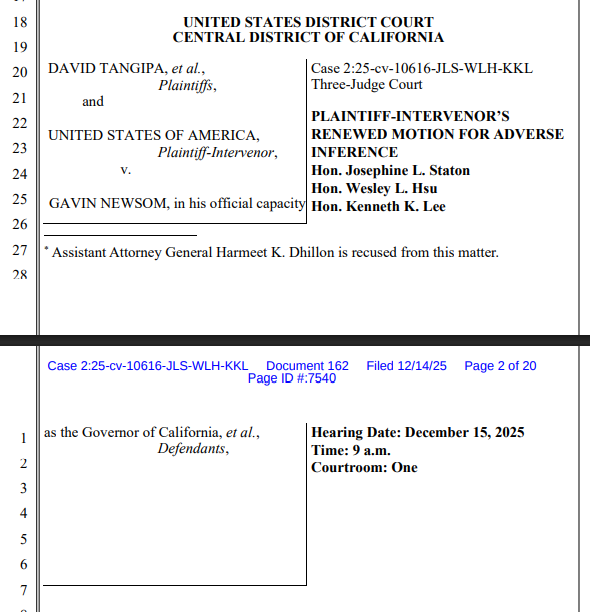
🚨 The United States has accused the @dccc and @paulmitche11 of SEVERE misconduct in its lawsuit challenging California's new congressional map.
— SCOTUS Wire (@scotus_wire) December 15, 2025
A 3 day hearing on the map is set to begin TODAY, and the US asks for a declaration that could win them the case.
DETAILS 🧵⬇️ pic.twitter.com/IAN4MGHl7R
The United States has accused the @dccc and @paulmitche11 of SEVERE misconduct in its lawsuit challenging California's new congressional map.
A 3 day hearing on the map is set to begin TODAY, and the US asks for a declaration that could win them the case.
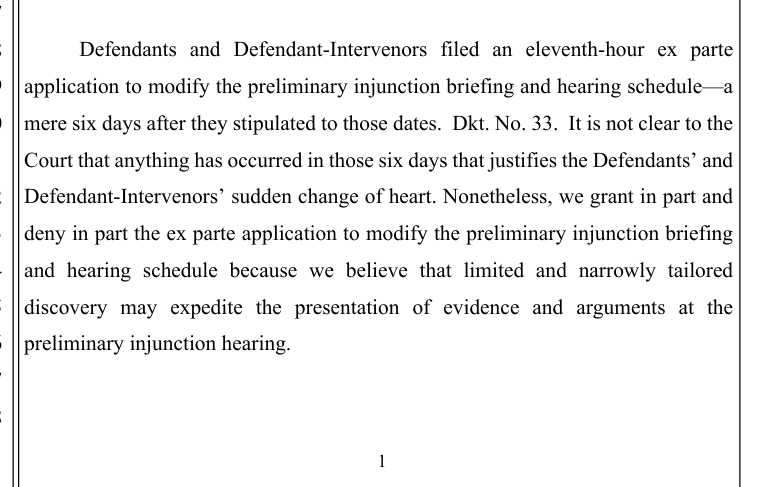
DETAILS 🧵⬇️Despite agreeing to a Dec. 3 hearing, CA tried to delay to January 20th, over a month after the date that it now admits it must have a map in place.
The court called this an "11th hour" move without a clear justification, but granted a delay to Dec. 15 to allow for DISCOVERY.The US subpoenaed all documents related to the drawing of the Prop 50 map and sought to depose Paul Mitchell, the person hired by the DCCC to draw the Prop 50 map.
The DCCC said that it conducted a reasonable search and found only privileged documents.
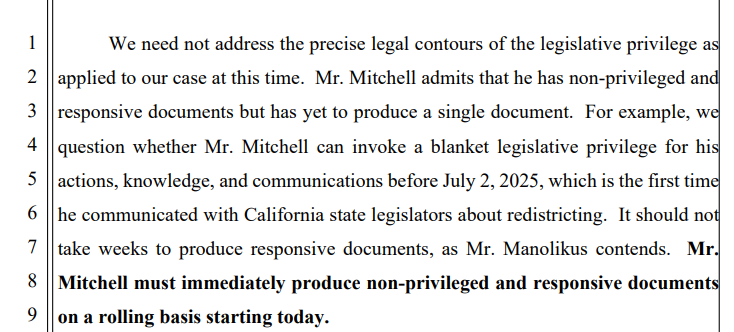
After delaying his deposition by 5 days, Mitchell's lawyer emailed the United States at 1:16 AM on the day of his deposition (12/10) saying that they would not be able to produce any documents before the hearing and that Mitchell would assert legislative privilege during the deposition.Following a US motion, a panel of judges on Saturday rejected several of Mitchell's claims and chided him for not producing a single document to the date of the order.
The court then ordered Mitchell to immediately turn over non-privileged documents ON A ROLLING BASIS.It took Mitchell almost 12 hours after the order to produce the first set of documents--3.4 GB--and he has not produced any more of the 45k documents as of the time of the DOJ's filing late last night.
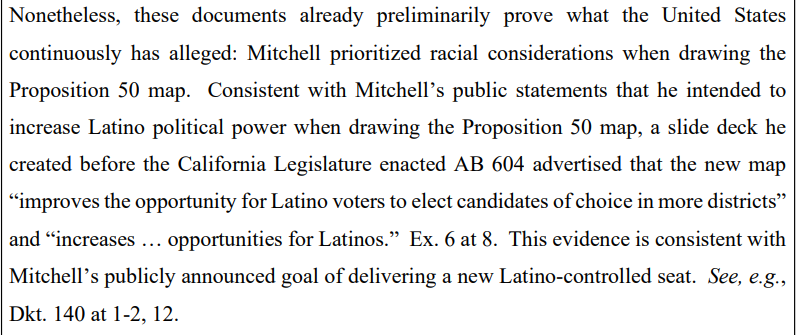
The US says that some of these documents prove that race was a predominant factor in the drawing of California's map.It doesn't stop there:
As it turns out, the DCCC has had control over these documents the ENTIRE TIME pursuant to its contract with Mitchell.
As a party in this case, the DCCC had an obligation to turn over such documents BY DECEMBER 1ST.
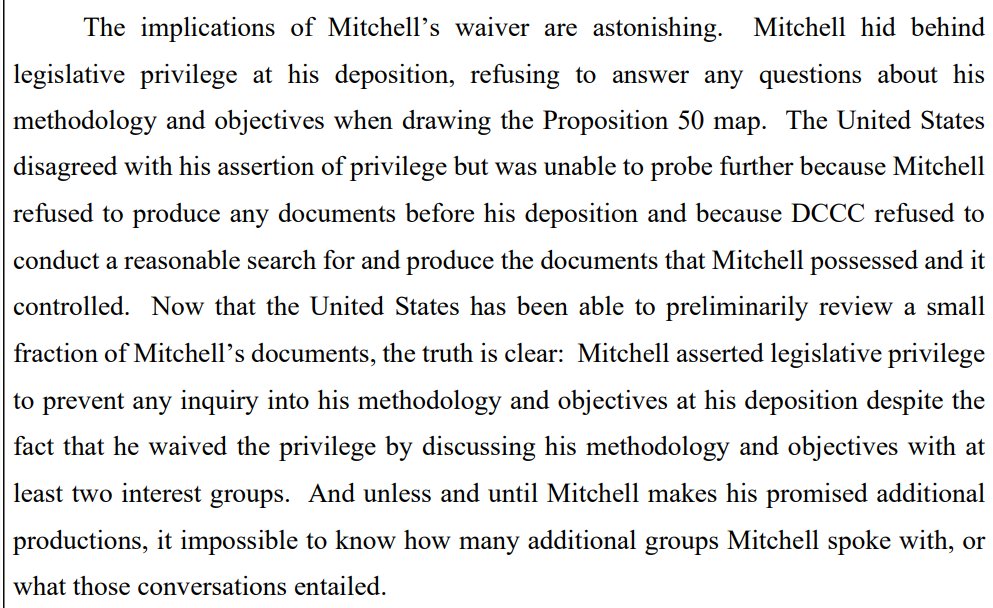
The evidence suggests that the DCCC DID NOT EVEN ASK Mitchell for these documents, but it represented to the parties and to the court that it conducted a reasonable search for the documents.Further, the evidence shows that Mitchell shared information that he claimed as privileged with third parties, INCLUDING THE DCCC and several advocacy groups including LGBT-rights group EQCA.
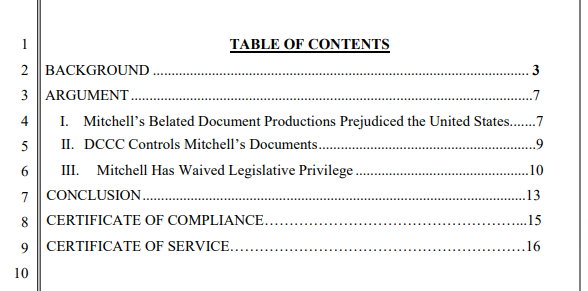
These actions constitute a waiver of privilege, which means that he SHOULD HAVE testified to the formulation of the Prop 50 map at his deposition, but refused to do so. The United States calls this "astonishing."Taken together, these actions by the DCCC and Mitchell deprived the United States of its ability to review relevant evidence as required under the Federal Rules of Civil Procedure before the hearing that starts TODAY.
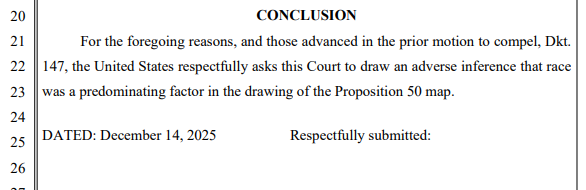
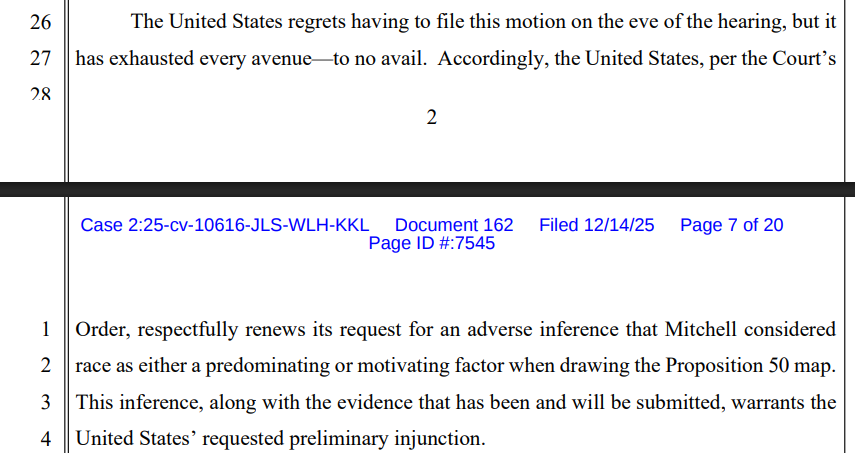
The limited evidence that the US did receive, however, proves that Mitchell considered race in the drawing of the map.Because of the prejudice that these actions caused the US, it asks the court to draw an averse inference that race was the predominant factor in the drawing of the Proposition 50 map.In racial gerrymandering lawsuits, if a plaintiff proves that race was the predominant factor in drawing the map, the State must show that it had a compelling interest to use race and that its use was narrowly tailored (strict scrutiny).
The issue for CA and defendants: they never made a strict scrutiny argument.
They've only argued that race was not the predominant factor. This constitutes a waiver, meaning that if the court finds that race predominated, the plaintiffs WIN the merits assessment.Additionally, under the VRA claim brought by the United States, they need only prove that race was a MOTIVATING factor in the drawing of the map, at which point the state must show, using evidence from BEFORE Prop 50's enactment, that it would have enacted that map regardless of race.
According to plaintiffs and the US, California has simply not submitted any evidence to that effect.This whole saga unfolded over the last 4 days, and the Court will begin its hearing on the map TODAY at 9 AM Pacific Time.
California contends that it needs a map by this FRIDAY, so all eyes are on the panel.• • •

Replies