
We aren’t a border state.
We aren’t near the Caribbean.
It just doesn’t make sense.
At least not until you go down the rabbit hole…
Y’all might want to buckle up. 🧵
Ever heard of them? Me either.
So I did some research. Who is Welcoming America? And what do they do?
Welcoming America is a U.S.-based nonprofit launched in 2009 with the goal of making communities “more inclusive” for everyone, regardless of where they were born.
It runs a nationwide network of roughly 300 cities, counties, and local organizations, offering them practical tools, training, certification programs (like Certified Welcoming places), and campaigns that help local leaders welcome IMMIGRANTS, strengthen social cohesion, and build broader community support for immigrant integration.
Does it matter if the immigrants are legal? NOPE!
And they’re VERY active in North Carolina. 🧵
welcomingamerica.org/?s=North+Carol…
One of them found this Thank You ad released by Welcoming America in 2024. 🧵
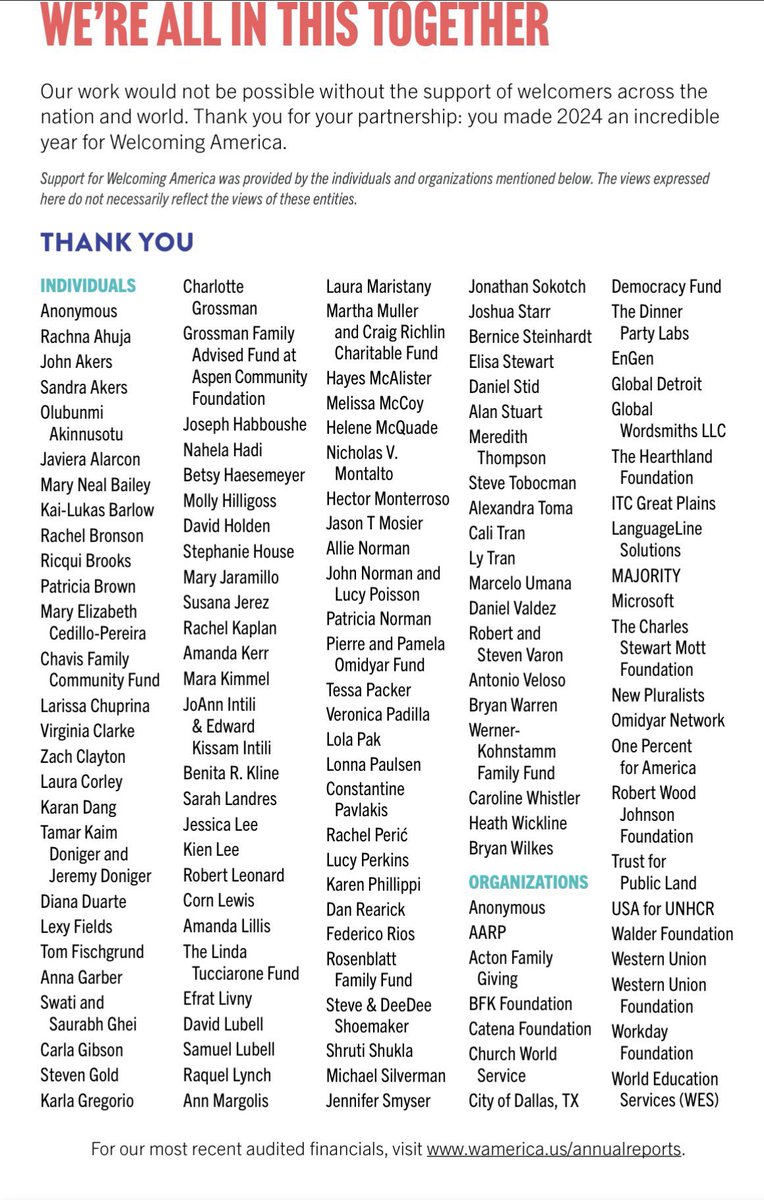
Did y’all know about this? Is there more to Welcoming America? If so, I’d be interested in hearing about it.
• • •
https://threadreaderapp.com/thread/1992264263604555832.html?utm_campaign=topunroll
Are they in your state? As of 2025, 36 cities and counties across the U.S. are Certified Welcoming
What are their goals?
This guide outlines the second iteration of the Certified Welcoming program and the Welcoming Standard criteria that communities must meet to earn the designation of Certified Welcoming.
Certified Welcoming is a formal designation for local governments that have created policies and programs reflecting their values and commitment to immigrant inclusion. This innovative program assesses local governments on their efforts to include and welcome immigrants in all areas of civic, social, and economic life in their communities.
This resource outlines the Certified Welcoming program’s new star designation system that allows communities to achieve one of five star designations for their welcoming efforts. Communities of all sizes and resources can now envision paths to deepen their work, gain new champions, and set goals for becoming Certified Welcoming.
Strong communities are ones that connect and include people of all backgrounds. By doing so, communities — and those who live there — will meet their highest civic, social, and economic potential. As local governments look to create more equitable and vibrant communities, welcoming and inclusive policies, programs, and practices will set themselves apart.
You can search and see if they have infiltrated your town here:
https://welcomingamerica.org/welcoming-network/network-directory?listing_paged=4
Yes, they target rural America!
They are partnered with E Pluribus - Global Detroit: Who is that?
E Pluribus equips local stakeholders with practical tools and relationships to foster the economic inclusion of immigrants in ways that lift local economies, foster growth, and enhance prosperity. E Pluribus works with immigrant-inclusive economic development practitioners, mayors, city councils, county commissions, governors, economic development agencies, community development organizations, ethnic community-based groups, and other nonprofits by:
- Serving as a network for local initiatives offering peer-to-peer learning and engagement opportunities that convene and connect practitioners;
- Expanding access to technical assistance and research supporting local immigrant inclusive economic development strategies, policies, practices, and programs;
- Building capacity of local immigrant inclusive economic development initiatives;
- Conducting research, engaging in communications, and serving as a laboratory for an academy of best practices and emerging trends in the field of immigrant-inclusive economic development;
- Engaging new sectors and partners to expand the movement of immigrant inclusive economic development, including, but not limited to, economic development organizations, chambers of commerce, employers, small business support ecosystems, community development, and housing development organizations, and the public, nonprofit and philanthropic sectors; and
Raising the voice and profile of local immigrant inclusive economic development initiatives with national organizations, policymakers, and leaders.
Their Values:
Our Values
- Inclusion is a superior economic model. Everyone has unique talents and contributions they make, which strengthen our communities and make our economy more resilient.
- Diversity, equity, inclusion, and belonging are critical. These pillars go beyond HR training and resource groups. Integrating these values into our work enhances our collective well-being and fuels economic growth.
- The power of local. Immigrant inclusion in economic development is a local endeavor. Local communities experience immigration impacts directly and are best equipped to design and implement successful inclusion strategies.
Of course, there is an International organization:
What we do
We support and connect civil society and government institutions seeking to advance inclusion in their cities and countries.
Access to a global network of practitioners, innovations and coaching
Support for developing, piloting, and refining Welcoming Standards and Frameworks.
Support for the development and management of national city networks.
Support in leading multi-sector welcoming planning processes as well as in researching the economic and social benefits of welcoming.
Their Criteria:
- CE 1.0 - Programs support immigrants in obtaining U.S. citizenship.
- CE 2.0 - Programs support eligible immigrants in voting.
- CE 3.0 - Programs support immigrants in developing civic leadership skills and are accessible to speakers of languages other than English.
- CE 3.1 - A program connects immigrants with local government departments and community resources with the goal of supporting immigrants in navigating and accessing these services.
- CE 3.2 - The program (CE 3.1) is accessible to speakers of languages other than English.
- CE 4.0 - Programs build immigrant youth leadership.
- CE 4.1 - Programs address barriers to immigrant participation in public hearings and meetings.
- CE 4.2 - Programs address language access needs for participation in public hearings and meetings.
- CE 5.0 - Programs address barriers to immigrant participation on local government commissions and boards.
- CE 5.1 - Programs address language access needs for participation in public boards and commissions.
- CE 5.2 - Programs engage state and/or local election offices on barriers to voting for eligible immigrants.
- CE 5.3 - Programs provide training to immigrant residents on accessing and using local government data and information
- EC 1.0 - Programs support immigrant job seekers in finding and obtaining employment.
- EC 1.1 - Programs support immigrant business owners in starting, sustaining, or growing their businesses.
- EC 2.0 - Programs support immigrant adults in accessing additional education to obtain the skills and degrees required to meet their employment goals.
- EC 2.1 - Programs address barriers for immigrant entrepreneurs and business owners.
- EC 3.0 - Local workforce agencies have information on current and projected demographic trends of the local immigrant population and the unique barriers faced by immigrant job seekers.
- EC 3.1 - Programs support immigrant job seekers in communicating foreign work experience and skills for U.S. employers.
- EC 3.2 - Chambers of commerce and/or economic development agencies are engaged in immigrant inclusion work.
- EC 4.0 - Programs support immigrants in meeting occupational certification and/or credentialing requirements.
- EC 4.1 - Programs support immigrant business owners in accessing capital to start, sustain, and grow their businesses.
- EC 5.0 - Programs work with relevant state agencies to address barriers to occupational licensing for immigrant residents.
- EC 5.1 - Programs work with employers to build welcoming work environments.
- EC 5.2 - Programs work with employers to identify and address barriers to hiring immigrant job seekers.
- EC 5.3 - Programs work with employers and immigrant employees to identify and address barriers to retaining immigrant staff.
- EC 5.4 - Programs address barriers to obtaining local government procurement and contracting opportunities.
- ED 1.0 - Programs address barriers to navigating local K-12 school district(s) for immigrant families.
- ED 1.1 - Local K-12 school districts provide language accessible information about the school system and services available to immigrant families.
- ED 1.2 Programs work to address barriers to adult English language classes.
- ED 2.0 - Programs support immigrant family engagement in their child’s education.
- ED 2.1 - Programs support immigrant students in understanding and accessing higher education opportunities.
- ED 2.2 - Programs address barriers to the adult education infrastructure for immigrant adults.
- ED 3.0 - Programs train K-12 educators and staff on teaching and supporting diverse student populations, including immigrant students.
- ED 3.1 - Programs support immigrant students in accessing career technical education.
- ED 3.2 - K-12 schools support immigrant students that have limited or interrupted formal education to attain their educational goals.
- ED 3.3 - Programs provide contextualized English language classes for adult English learners.
- ED 4.0 - Programs work with K-12 schools to regularly collect feedback from immigrant families on the school environment.
- ED 4.1 - Programs address barriers to participation in family engagement programs for immigrant families.
- ED 4.2 - Programs address barriers to early childhood education and care for immigrant children.
- ED 5.0 - K-12 schools accommodate diverse cultural and religious practices in daily operations.
- ED 5.1 - Programs support immigrant students in accessing mental health services.
- ED 5.2 - Programs engage the state government on expanding access to adult education programs for immigrant adults.
- ED 5.3 - Prog
- EA 1.0 - Local government departments disseminate information on government services, resources, and public benefits with the goal of expanding access to immigrants.
- EA 2.0 - Information from the local government (EA 1.0) is communicated through outreach methods that are proven to be effective in reaching immigrant residents.
- EA 2.1 - Programs address barriers to immigrants accessing and navigating preventative healthcare.
- EA 2.2 - Programs inform immigrants of workers’ rights.
- EA 2.3 - Programs address barriers to digital inclusion for immigrant residents.
- EA 3.0 - Information from the local government (EA 1.0) is provided in languages other than English.
- EA 3.1 - Programs address barriers to immigrants accessing immigration legal services.
- EA 3.2 - Programs address barriers to immigrants accessing and navigating maternal and infant healthcare.
- EA 4.0 - Programs address barriers to immigrants accessing and navigating mental health services.
- EA 4.1 - Programs address barriers to accessing rental housing for immigrants.
- EA 4.2 - Local mobility planning efforts address the needs and priorities of immigrant residents.
- EA 4.3 - Programs address barriers to immigrants in accessing civil legal services.
- EA 5.0 - Information from the local government (EA 1.0) is proactively written and designed with translation and the diversity of residents in mind.
- EA 5.1 - Programs address barriers to homeownership for immigrants.
- EA 5.2 - Programs work with the state government and/or regional transit authorities on expanding access to transportation, including addressing the needs and priorities of immigrant residents.
- EA 5.3 - Programs provide training to those in the legal system on the potential impact of criminal convictions on residents with different immigration statuses.
- rams engage the state government on expanding access to early childhood education and care programs for immigrant children.
-
- GL 1.0 - The local government has one or more staff positions whose responsibilities include advancing immigrant inclusion.
- GL 1.1 - The local government has a process in place to ensure regular communication with immigrant residents.
- GL 1.2 - Public libraries implement an immigrant inclusion strategy.
- GL 2.0 - The local government leadership has an immigrant inclusion strategy for its departments and agencies.
- GL 2.1 - A group of local leaders and residents regularly convenes to advance immigrant inclusion efforts.
- GL 2.2 - Participants of the group advancing immigrant inclusion (GL 2.1) reflect the diversity of the community in demographics, constituencies, and sectors.
- GL 2.3 - The group advancing immigrant inclusion (GL 2.1) has a process in place to ensure regular bidirectional communication with immigrant communities.
- GL 2.4 - The group (GL 2.1) informs local government staff and is able to provide direct feedback on issues impacting and priorities of the immigrant community.
- GL 2.5 - Local recreational programs implement an immigrant inclusion strategy.
- GL 3.0 - Local government departments know the demographics of the immigrant population and have access to tools to serve these residents.*
- GL 3.1 - The local government has a language access policy that includes interpretation and translation protocols for all externally facing government departments.*
- GL 3.2 - The local government provides regular training to its staff about language access requirements, available resources to provide meaningful language access, and working with speakers of languages other than English.*
- GL 3.3 - The local government regularly assesses language access needs and usage across departments in order to improve each department’s ability to conduct business in languages other than English.*
- GL 4.0 - A community-wide strategy for immigrant inclusion is set through a feedback process including immigrant and non-immigrant residents representing the diversity in the community.
- GL 4.1 - There is a process in place to regularly update the strategy (GL 4.0) with feedback from immigrant and non-immigrant residents.
- GL 4.2 - Local government departments annually set and monitor goals for immigrant inclusion informed by the needs of immigrant residents and the community-wide strategy (GL 4.0).*
- GL 5.0 - Local government departments have programs that build relationships with immigrant residents.*
- GL 5.1 - Local government departments have programs that address the needs and priorities of immigrant residents.*
- GL 5.2 - Local government departments receive training on working with diverse populations, including immigrants.
- GL 5.3 - Programs engage regional jurisdictions on adopting and implementing welcoming policies and programs across the region.
- GL 5.4 - The local housing authority implements an immigrant inclusion strategy.
* For Government and Community Leadership criteria designated with an asterisk (*), all of the following local government departments are expected to meet these criteria:
Child protective services • Communications • Department(s) that enforce building, construction, fire, health, and housing codes • Economic development • Emergency dispatch • Emergency management • Emergency medical services (EMS) • Fire • Human resources • Law enforcement • Neighborhoods • Planning • Purchasing • Public health • Zoning

Replies