

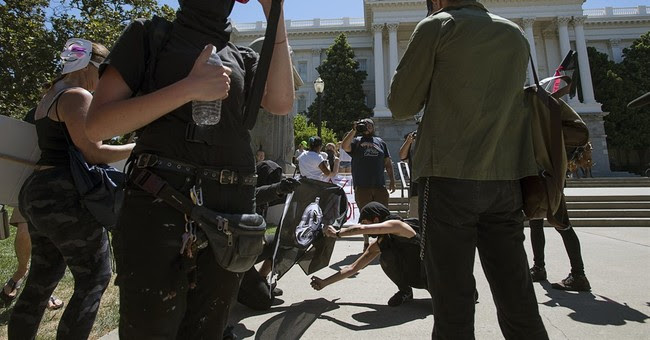
Anti-fascist activists, or “antifa,” increasingly mobilized in the wake of President Trump’s election, are unapologetic about what they describe as the necessary use of violence to combat authoritarianism.
While both experts on the movement and activists within it emphasize that not everyone who participates in anti-fascist activism engages in violence, they say the use of force is intrinsic to their political philosophy.
“The justification [of the use of violence] is that Nazi ideology at its very core is founded on violence and on wielding power by any means,” said Mike Isaacson, one of the founders of Smash Racism D.C., an antifa organization in Washington.
Isaacson is unequivocal in his defense of violence as a legitimate tool to combat the creeping threat of what he deems authoritarianism.
“There is the question of whether these people should feel safe organizing as Nazis in public, and I don’t think they should,” said Isaacson.
“I don’t think anyone should think that someone who is intent on politically organizing for the sake of creating a state-sponsored genocide — I don’t think is something that we should protect,” he said.
Antifa activists justify their use of violence as self-defense against “the inherent danger of fascists organizing,” according to Mark Bray, a Dartmouth historian and author of a recent book on the movement.
“The argument is that it needs to be stopped immediately, because if you let it grow, that poses a danger to society,” Bray said.
Dubbed the “alt-left” by President Trump, antifa has increasingly been making their presence known after his victory in the 2016 election was openly embraced by white supremacists.
On Sunday, antifa protesters hurled glass bottles and bricks at police officers monitoring a far-right march in Portland, Ore.
And the University of California, Berkeley, is bracing for the possibility of more violent clashes on Thursday, when conservative political commentator and former Breitbart editor Ben Shapiro is scheduled to speak.
There is no central organizing committee governing antifa, and different affiliated groups have different priorities and governing principles, making it impossible to gauge the growth of the movement in the wake of the election.
But activists and law enforcement sources say anecdotally that their numbers have almost certainly swelled. Jim Pasco, executive director of the Fraternal Order of Police, the nation’s largest law enforcement union, told The Hill that he has “for sure” seen rising interest in the movement since Trump’s election, noting that six months ago he had never even heard of antifa.
As early as 2016, the Department of Homeland Security and the FBI warned state and local officials that antifa had become increasingly confrontational and were engaging in “domestic terrorist violence.”
While Bray says antifa focuses mostly on nonviolent activities, such as researching white supremacists and disrupting their efforts to organize, the movement’s more violent methods — and its use of so-called black bloc tactics, where activists wear black masks and clothing to conceal their identity — have drawn fierce criticism from the right and divided the left.
.Liberal activist Cornel West, in contrast, said that antifa activists saved him and other counterprotesters in Charlottesville, Va., from “being crushed like cockroaches” by "alt-right" demonstrators.
The antifa movement traces its roots to militant leftists who combated fascism in the streets of Europe in the 1920s and 1930s. The movement saw a revival in response to neo-Nazi activity in the U.K. and Germany in the 1970s, 1980s and 1990s.
The philosophy was first transposed to the U.S. in the 1980s by anti-racist activists in Minneapolis, according to Bray, and while its popularity has ebbed and flowed since then, there are several current groups that have been around for almost 10 years. Rose City Antifa in Portland, Ore., for example, was established in 2007.
If the loosely affiliated network of far-left activists can be said to have a creed, it is to combat what it sees as fascism wherever it occurs.
Rose City Antifa defines fascism as “an ultra-nationalist ideology that mobilizes around and glorifies a national identity defined in exclusive racial, cultural, and/or historical terms, valuing this identity above all other interests (ie: gender or class).”
Antifa also tend to be deeply mistrustful of the police and often overlaps ideologically with anarchism, a political philosophy that Isaacson defines as a society built on cooperation and mutual aid. Isaacson, who is an anarchist, argues that in order to be successful, anti-fascism has to operate outside of government.
“Getting state involved in this is no better than letting the Nazis go free,” he said, pointing to the Virginia State Police response to the violence at the white supremacist rally in Charlottesville, which many protesters and counterprotesters criticized as too slow.
Activists, including Isaacson, claim that police departments and the military have been infiltrated by Nazis and “have them kind of on their side.”
Pasco insists that police officers are agnostic as to whether a person committing a crime is antifa or "alt-right."
“We don’t really have a perspective on [antifa] because it’s not really a movement — it’s kind of an amorphous group of people,” Pasco said.
“Nobody gets policed unless they need policing — there are just not enough police officers in the United States to satisfy the vanity of those who believe they are under constant surveillance,” he said.
Others see evidence of a disproportionate police response to antifa activists, such as those who criticized law enforcement in Portland for firing rubber bullets and stun grenades into a crowd of antifa protesters on Sunday.
“The way law enforcement has reacted to the protests far exceeds the amount of danger involved, particularly when we talk about violence at far-right protests — because there is a long and deep history of murderous violence coming out of the far-right movements that continues up to today that far exceeds anything associated with antifa,” said Mike German, a former FBI agent who works on law enforcement issues at the Brennan Center for Justice’s Liberty and National Security Program.
Antifa’s use of violence continues to dominate the national conversation. In January, shortly after a black-clad protester attacked the far-right activist Richard Spencer, The New York Times mused: “Is it OK to punch a Nazi?”
Isaacson, for his part, has not engaged in the use of violent tactics himself, “if for no other reason than I’m rather slight of frame,” he said with a chuckle.
“I’m not so good in a fight,” he said.























Sep 15 2017
Every Western nation that has opened its borders to Muslim illegal aliens posing as asylum seekers needs to read this
Middle East Forum One evening, the blue-grey sky grumbled shortly after sunset. The thick clouds blackened and rain poured down over the city with a roar. As I ran across the slippery pavement into a friend’s bar, I heard a group of five poor souls speaking Persian with a Turkic accent and running amok, seeking shelter under the eaves of a building.
A quarter of an hour later I found them in front of my friend’s bar, totally soaked. I went out and asked them if they spoke English; they shook their heads. I asked them in Turkish if they spoke Turkish. With glittering eyes, three of them cheerfully said, “Evet!” [“Yes” in Turkish]. I told them they could come into the bar if they liked. They hesitated but politely declined. I asked if they needed food, water, or cigarettes.
Nearly two years later, on a beautiful and cool summer evening, I met A. at a bar on the same island. A., a Syrian refugee, often spends his evenings bar-hopping with his Western friends. Those friends are mostly romantic European social workers who, I observed several times, sport t-shirts, bags, and laptops festooned with the Palestinian flag. They are on the island to help the unfortunate Muslim refugees who are fleeing war in their native countries.
“I’ll tell you strictly Muslim-to-Muslim,” A. said in good English after having poured down a few shots of whiskey. “These (European social workers) are silly. I don’t know why on earth they are in love with a Muslim cause that even some of us Muslims despise.”
Last year, three Afghans stopped in front of my house on the same island and asked for drinking water. I gave them three bottles and asked if they needed anything else. Coffee? They accepted and sat down in the garden chairs.
Over coffee, they said they were glad to be hosted “not by an infidel on this infidel island” but by a Muslim. The young Afghan who was dressed like a dancer from a cheap hip-hop clip on MTV said, “One day we good Muslims will conquer their infidel lands.” I asked why he was receiving “infidel” money for living. “It’s just halal,” he answered. “They [‘infidels’] are too easy to fool.”
M., another fluently English-speaking Syrian, gave me a long lecture on the wonderful governance of Turkish President Recep Tayyip Erdoğan. “Turkey is the best country in the world!” M. said. ” Erdoğan is the leader of the ummah.”
I asked why he had risked his life to cross illegally from the “best country in the world” to the “poor, infidel lands.” “I want to go to Europe to increase the Muslim population there,” he said. “I want to make a Muslim family there. I want to have plenty of children.” I reminded him that Greece, too, is a European country. No it’s not, he answered.
Almost all the illegal migrants on that and other Greek islands want to get to Germany, where they have heard from friends and relatives that they will be the best paid for being “poor” refugees.
The cliché “the-poor-souls-are-fleeing-war-in-their-native-country” is becoming less and less convincing every day. True, most Syrians fled to Turkey after the start of civil war in their country. But why did they then risk their lives to squeeze into 12-man rubber boats with 40-50 other people, including children and the elderly? Because of war in Turkey? No.
Despite political instability and insecurity for all, there is technically no war in Turkey. It is a Muslim country whose mostly Muslim migrants want to leave it as soon as possible for non-Muslim Europe.
They reach the shores of the Greek islands, which are so beautiful that people from across the world fly there for their holidays. But the islands are not good enough. They want to go to Athens. Why? Because there is war on the Greek islands? No. It’s because Athens is the start of the exit route to the Balkans.
Apply the same logic to Serbia, Hungary, and Austria. Like Greece, none of those countries will be good enough for the refugees. Why not? Because there is war in Serbia or Hungary or Austria? Or because “my cousin tells me Germans pay the best?”
Turkey’s leaders often threaten Europe that they will “open the gates” and flood Europe with millions of refugees. They should ask themselves instead why those Muslim refugees are so eager to leave the “new Turkish empire” if given the chance. Why would they choose not to live a comfortable life in a powerful and peaceful Muslim country and instead flock to the “infidel” west?
Erdoğan blames the West for the tragedy. He has criticized the West for having taken only 250,000 Syrian refugees. In 2016, then Turkish Prime Minister Ahmet Davutoglu said the United Nations Security Council’s five permanent members (the US, Russia, Britain, France, and China), should pay the price, not Syria’s [Muslim] neighbors.
It is ironic that millions of Muslims are trying, through dangerous means, to reach the borders of a civilization they have historically blamed for all the world’s evils, including those of their own countries. The “romantic” West does not question why millions of West-hating Muslims are heading in their direction. Or is it “Islamophobic” to point out that there is no war in Greece, Serbia, Hungary, or Austria?
By BareNakedIslam • Muslim Invaders • 0