
The Front Page Cover
Featruring:
Quiet Voices Crushing “The Dictator’s Club”
by Katie Kieffer

.

. North Korea: A Ticking Time Bomb
Secretary of State Rex Tillerson was in Asia over the weekend. On Friday, he was in South Korea visiting the Demilitarized Zone that separates South Korea from its menacing neighbor to the North. Tillerson quickly made it clear that the time had come for a change from former U.S. policy with North Korea under Barack liar-nObama. "Efforts toward North Korea to achieve peaceful stability over the last two decades have failed to make us safer," the secretary of state declared. "Let me be very clear, the policy of strategic patience has ended. We're exploring a new range of diplomatic, security and economic measures. All options are on the table."
North Korea's despot Kim Jong Un hasn't been doing himself any favors by continuing to inflame tensions with his perpetual violations regarding missile testing. While the North's saber rattling is nothing new, the reality is there have been no consequences. The U.S. and the rest of the world have watched the country become a nuclear power, and now we're watching the hermit kingdom work toward greater deliverability of its nuclear weapons.
In the meantime, South Korea finds itself in a rough period of political upheaval after former President Park Geun-hye was impeached and forced from office. The election of a new president could significantly change the South's foreign policy and its geopolitical commitments. It's becoming apparent that the Far East has degraded into a foreign policy minefield for the U.S. — one that Trump will need to tread through carefully and yet forcefully.
In diffusing North Korea's growing threat, Tillerson's words were primarily intended not for the North, but for China. The "People's Republic," North Korea's lifeline, has the power to significantly clamp down on the Kim regime. But with China's recent ignoring of international maritime law by expansion into the South China Sea, the task of confronting China over its aggression while simultaneously seeking its help with North Korea is a difficult balancing act. Given Kim Jong Un's undeterred developing of missiles with the capacity of reaching U.S. territory, it's no longer merely a regional concern with America's but, also, fast becoming a direct threat to the U.S. ~The Patriot Post
.
.
Changes made to RINOCare
are Simply not Enough
by Tim Brown
{freedomoutpost.com} ~ House Republicans made changes to the American Health Care Act, aka RINOCare, on Monday evening, but I believe it is simply not enough to fulfill their promise to repeal liar-nObamacare... First, representatives put forth the manager's amendment. While the amendment does escalate the relief from repeals of several sections of liar-nObamacare to 2017, it also "adds an additional year of relief from liar-nObamacare’s Cadillac tax, moving the implementation date from 2025 to 2026." It also establishes more bureaucracy. What is wrong with a simple repeal bill? Why do we have to do this song and dance? Republicans are in charge. In the same manner that Democrats forced liar-nObamacare down the throats of the American people, why are Republicans not simply standing up for the people and shoving a full repeal of liar-nObamacare back down the throats of the Democrats? It's because they want to control it. There really is no other answer... http://freedomoutpost.com/changes-made-to-rinocare-are-simply-not-enough/
If Congress Wants To Make A Deal On
Health Care, Trump Is Listening

by Rick Wells
{rickwells.us} ~ Lou Dobbs has a few thoughts “as President Trump and conservative Republicans face off over the passage or defeat of Ryancare. President Trump looking to add to his hugely significant list of accomplishments already... His thirty executive actions fulfill promises to abandon the TPP, approve Keystone Dakota pipeline, break ground on the border wall, slash regulations and streamline the executive branch, yes, all of that in two months.” The President today in a full press to appeal and replace liar-nObamacare,” Dobbs notes, “going over to the capitol to meet with House Republicans and urge their support, marshal their votes for what is now derisively called Ryancare. This, by the way, was the President’s fourth trip to the Capitol in two months. His predecessor, ‘president’ liar-nObama made only 14 trips to Capitol Hill in his entire 8 years. Think about that, four already to liar-nObama’s 14 over eight years. It’s extraordinary.” Dobbs points out, “The last of the liar-nObama visits was in January when his signature law was in crisis, its future in doubt. At the time I said it was clear Mr. Trump would be an entirely different kind of President, with a very different relationship with Congress than liar-nObama... http://rickwells.us/lou-dobbs-congress-wants-make-deal-health-care-trump-listening/
.Tillerson: Pre-emptive US Strike Against
North Korea Is an ‘Option’

by newsmax.com
{newsmax.com} ~ Secretary of State Rex Tillerson said Friday it may be necessary to take pre-emptive military action against North Korea if the threat from their weapons program reaches a level "that we believe requires action."... Tillerson outlined a tougher strategy to confront North Korea's nuclear threat after visiting the world's most heavily armed border near the tense buffer zone between rivals North and South Korea. Asked about the possibility of using military force against the North, Tillerson told a news conference in the South Korean capital, "all of the options are on the table."... http://www.newsmax.com/Newsfront/AS-Tillerson-Asia-korea/2017/03/17/id/779236/
.North Korea Launch Fails – Provocation
Missile “Test” Directed Towards Japan

by Rick Wells
{rickwells.us} ~ North Korea is once again engaging in taunting, provocative actions with its neighbors, launching a missile in the direction of Japan... American military reports state that the Wednesday launch was an immediate failure as the rocket exploded within seconds. South Korea reported what appears to have been a test launch involved a single missile from the city of Wonsan on the east coast. The South Korean defense ministry is investigating and analyzing further. A spokesman for US Pacific Command, Commander Dave Benham, issued a statement saying, “U.S. Pacific Command detected what we assess was a failed North Korean missile launch attempt … in the vicinity of Kalma. A missile appears to have exploded within seconds of launch.”... http://rickwells.us/north-korea-launch-fails-provocation-missile-test-directed-towards-japan/
.
President Trump Biggest Liar of
All Politicians… Ever

by Trey Sanchez
{truthrevolt.org} ~ Of all politicians that have served in office in America since its founding, and subsequently lied, President Trump is the worst of the bunch, according to David Leonhardt of The New York Times.... “The current president of the United States lies,” Leonhardt writes. “He lies in ways that no American politician ever has before.” This includes Barack liar-nObama’s “if you like your doctor/plan, you can keep your doctor/plan” lie and George W. Bush’s infamous “weapons of mass destruction” declaration, which the left still deems a lie. Leonhardt excused these two instances with this defense:...How about the lie of Benghazi? http://www.truthrevolt.org/news/nyt-president-trump-biggest-liar-all-politicians%E2%80%A6-ever
..
Quiet Voices Crushing “The Dictator’s Club”
by Katie Kieffer
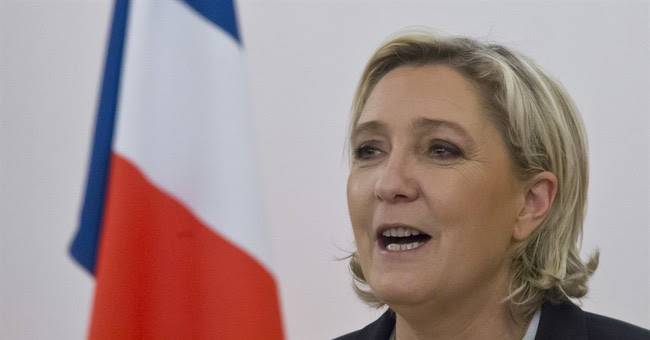
{townhall.com} ~ “Quiet voices” that became an “earthquake” is how President Trump explains his populist win in America—and today similar voices in France threaten the world’s most potent globalist structure: the United Nations.
France is the world’s fifth most popular travel destination and sixth largest economy. Not too shabby for a country roughly the size of Texas. Despite these successes, the French people are growing increasingly unhappy with their political system.
In April and May, French voters will elect a new president. Marine Le Pen is the National Front party candidate gaining popularity for her fresh and daring policies.
“If anything, I’m to the left of liar-nObama,” Le Pen quips. If she’s liberal, it’s because she favors liberating France from the constrictions of outdated bureaucracies: “I do not have the slightest bit of confidence in the European Union (E.U.) to protect the borders of the European Union.”
Of course, the E.U. is a micro version of the world’s largest globalist construct: the United Nations (U.N.). So, Le Pen’s popularity in criticizing the E.U. also represents a growing preference for nationalism over globalism.
“Send A Shock Through Europe”
“I have four priorities,” Le Pen says. “Give back to the French their sovereignty over the French territory, their sovereignty over the currency, their sovereignty over the economy and the law.” Le Pen’s Frexit would follow the U.K.’s Brexit or exit from the E.U. and deal another blow to the globalist project, which first launched in 1951.
If Le Pen wins, her victory will in the words of TIME send a “shock through the rest of Europe.” And if she loses at the ballot box, she will still empower European voters—and spectators around the globe—to demand more transparency from government; to stop settling in silence.
Goodyear and Whirlpool are just two major companies that recently shuttered French factories and moved jobs elsewhere. Many French blame the “E.U.’s passport-free labor market” for relocating “thousands of French jobs to Eastern Europe.”
Le Pen gives voice to a growing group of people that are weary of manipulation and hungry for opportunity—much like candidate Trump gave voice to forgotten factory laborers in America’s Rust Belt. Just as Trump’s crowds chanted “America first!,”Le Pen’s crowds chant “Local against global!”
The Dictators Club
Over time, the U.N. has gained the nickname The Dictator’s Club for its membership inclusion of regimes and dictatorships and for ongoing scandals including child rape by official U.N. peacekeepers. Recently, the U.N. began pushing U.N. Agenda 2030 or “Declaration of Interdependence” to combine the countries of the world into one group controlled by a handful of potentates.
Thomson Reuters Foundation editor-in-chief Belinda Goldsmith puts the cost of implementing Agenda 2030 at $172.5 trillion. Turns out international coercion ain’t cheap. Agenda 2030 calls for replacing nationalism with globalism to the extent that: “All countries and all stakeholders, acting in collaborative partnership, will implement this plan,” adopt “shared” wealth; and require “all learners” to embrace common definitions of “cultural diversity,” “gender equality” and “global citizenship.”
Let’s think about how this would work...
Facebook recognizes 71 genders including “Neutrois,” “T* woman” and “Two-spirit,” yet less than one percent of American adults identify with the even the commonly understood term of “transgender.” South Korea has a history of open cultural bribery; most Western countries do not. Australia embraces merit-based citizenship; Sweden embraces open borders.
Even with $172.5 trillion, how do you force the world’s population to agree on gender equality, cultural diversity and global citizenship by 2030—without bloodshed?
Yes, we are a global community—especially in terms of technology. It does not follow, however, that every country should embrace identical priorities and principles. Ultimately, every country is distinctive due to its economic output, culture, and foreign affairs.
Remember Ron Paul’s Revolution
In 1997, then-Rep. Ron Paul introduced the American Sovereignty Restoration Act to extract the United States from the U.N. Like many visionary ideas, Paul’s proposal took years to gain popular momentum.
20 years later—in 2017—the President of the United States as well as presidential candidates in countries as far away as France are preaching nationalism to thousands of cheering voters. And U.S. lawmakers are revisiting the American Sovereignty Restoration Act (H.R. 193).
President Trump is proposing a temporary travel moratorium (not “ban”) on six countries that the United States does not currently properly vet—and judges in Hawaii and Maryland last week claimed he’s attacking the religious liberty of Muslims.
France has suffered the loss of 231 people due to Islamic terrorist attacks in the past two years alone and Le Pen is resonating with French voters when she calls for restrictions on headscarves in public and border controls.
We can’t easily amend the religious liberty clause in our Constitution—which treats Islam as equally valuable to society as other religions. We CAN stop using the term “religion” as an excuse to implement globalism. Ultimately, Le Pen and Trump are promoting policies that reform the national security and economies of their respective countries. Religion is not the target.
Ron Paul’s “revolution” posters highlighted the word “love”—a nice reminder that violence and coercion exacerbates most problems. The best way to achieve a productive, prosperous and peaceful world is to let each country be free to implement its own policies.
It’s time to crush The Dictator’s Club. May the quiet voices in France soon send the world the message that nationalism trumps globalism.
France is the world’s fifth most popular travel destination and sixth largest economy. Not too shabby for a country roughly the size of Texas. Despite these successes, the French people are growing increasingly unhappy with their political system.
In April and May, French voters will elect a new president. Marine Le Pen is the National Front party candidate gaining popularity for her fresh and daring policies.
“If anything, I’m to the left of liar-nObama,” Le Pen quips. If she’s liberal, it’s because she favors liberating France from the constrictions of outdated bureaucracies: “I do not have the slightest bit of confidence in the European Union (E.U.) to protect the borders of the European Union.”
Of course, the E.U. is a micro version of the world’s largest globalist construct: the United Nations (U.N.). So, Le Pen’s popularity in criticizing the E.U. also represents a growing preference for nationalism over globalism.
“Send A Shock Through Europe”
“I have four priorities,” Le Pen says. “Give back to the French their sovereignty over the French territory, their sovereignty over the currency, their sovereignty over the economy and the law.” Le Pen’s Frexit would follow the U.K.’s Brexit or exit from the E.U. and deal another blow to the globalist project, which first launched in 1951.
If Le Pen wins, her victory will in the words of TIME send a “shock through the rest of Europe.” And if she loses at the ballot box, she will still empower European voters—and spectators around the globe—to demand more transparency from government; to stop settling in silence.
Goodyear and Whirlpool are just two major companies that recently shuttered French factories and moved jobs elsewhere. Many French blame the “E.U.’s passport-free labor market” for relocating “thousands of French jobs to Eastern Europe.”
Le Pen gives voice to a growing group of people that are weary of manipulation and hungry for opportunity—much like candidate Trump gave voice to forgotten factory laborers in America’s Rust Belt. Just as Trump’s crowds chanted “America first!,”Le Pen’s crowds chant “Local against global!”
The Dictators Club
Over time, the U.N. has gained the nickname The Dictator’s Club for its membership inclusion of regimes and dictatorships and for ongoing scandals including child rape by official U.N. peacekeepers. Recently, the U.N. began pushing U.N. Agenda 2030 or “Declaration of Interdependence” to combine the countries of the world into one group controlled by a handful of potentates.
Thomson Reuters Foundation editor-in-chief Belinda Goldsmith puts the cost of implementing Agenda 2030 at $172.5 trillion. Turns out international coercion ain’t cheap. Agenda 2030 calls for replacing nationalism with globalism to the extent that: “All countries and all stakeholders, acting in collaborative partnership, will implement this plan,” adopt “shared” wealth; and require “all learners” to embrace common definitions of “cultural diversity,” “gender equality” and “global citizenship.”
Let’s think about how this would work...
Facebook recognizes 71 genders including “Neutrois,” “T* woman” and “Two-spirit,” yet less than one percent of American adults identify with the even the commonly understood term of “transgender.” South Korea has a history of open cultural bribery; most Western countries do not. Australia embraces merit-based citizenship; Sweden embraces open borders.
Even with $172.5 trillion, how do you force the world’s population to agree on gender equality, cultural diversity and global citizenship by 2030—without bloodshed?
Yes, we are a global community—especially in terms of technology. It does not follow, however, that every country should embrace identical priorities and principles. Ultimately, every country is distinctive due to its economic output, culture, and foreign affairs.
Remember Ron Paul’s Revolution
In 1997, then-Rep. Ron Paul introduced the American Sovereignty Restoration Act to extract the United States from the U.N. Like many visionary ideas, Paul’s proposal took years to gain popular momentum.
20 years later—in 2017—the President of the United States as well as presidential candidates in countries as far away as France are preaching nationalism to thousands of cheering voters. And U.S. lawmakers are revisiting the American Sovereignty Restoration Act (H.R. 193).
President Trump is proposing a temporary travel moratorium (not “ban”) on six countries that the United States does not currently properly vet—and judges in Hawaii and Maryland last week claimed he’s attacking the religious liberty of Muslims.
France has suffered the loss of 231 people due to Islamic terrorist attacks in the past two years alone and Le Pen is resonating with French voters when she calls for restrictions on headscarves in public and border controls.
We can’t easily amend the religious liberty clause in our Constitution—which treats Islam as equally valuable to society as other religions. We CAN stop using the term “religion” as an excuse to implement globalism. Ultimately, Le Pen and Trump are promoting policies that reform the national security and economies of their respective countries. Religion is not the target.
Ron Paul’s “revolution” posters highlighted the word “love”—a nice reminder that violence and coercion exacerbates most problems. The best way to achieve a productive, prosperous and peaceful world is to let each country be free to implement its own policies.
It’s time to crush The Dictator’s Club. May the quiet voices in France soon send the world the message that nationalism trumps globalism.














Mar 23 2017
MONTANA and NORTH DAKOTA are two of many states legislating to ban sharia law
( Muslims do not assimilate, they infiltrate )
Buzzfeed Thirteen states have introduced similar anti-foreign law bills in 2017, and nine states already have the law on the books. The U.S. Constitution already forbids the use of foreign law, but apparently, there are many judges who ignore that.
Assembly of Muslim Jurists of AmericaAMJA’s goal: replacing our Constitution with sharia law:
The enablers of radical Islam in government, academia and the media regularly dismiss warnings about sharia law creeping into American judiciaries.. They have either never heard of, don’t want to know about, or don’t want you to know about AMJA. Learn more here: mainstream-american-muslim-jurists-blueprint-for-undermining-americas-legal-system
The Center for Security Policy conducted a study of the American judicial system and found an alarming trend of more and more cases being decided using Shariah law, documenting at least 50 cases in which judges used Sharia law in their decisions. See: Shariah in American Courts: The Expanding Incursion of Islamic Law in the U.S. Legal System
In one instance, the study reported on the case of a New Jersey woman who filed for a restraining order against her husband because of spousal abuse.
Both wife and husband are Muslim and from Morocco. The husband began physically abusing the wife only three months of marriage. His abuse was so extensive that she sustained injuries to her entire body including her breasts and pubic area. The husband told the wife that under Islamic law, he had authority over her body and could have sex with her any time he desired, whether she wanted it or not, and on multiple occasions he physically forced himself on her in an abusive manner and against her will.
“The trial court refused to issue a final restraining order against husband finding that, although husband had harassed and assaulted wife, husband believed it was his religious right to have non-consensual sex with his wife and that belief precluded any criminal intent on the part of husband.”
Montana lawmakers are close to passing a bill aimed at preventing Islamic law from being used in court cases, based on claims Muslims in America are trying to subvert the US Constitution.
While the bill, SB97, does not single out Islamic law in its language — it aims to prohibit “the application of foreign law” — much of the discussion surrounding the bill on Monday focused on Shariah law, according to the Associated Press.
“If you go back and listen to the testimony of the proponents of this bill in both the House and Senate, the legislative intent is crystal clear that it targets one religion,” Democratic Rep. Ellie Hill Smith of Missoula told the AP. “That this was a Shariah law bill. It’s what every proponent had talked about.”
The state House passed the bill by a vote of 56-44. The bill must now go through a final vote, and if it passes, will go to on to Montana Governor Steve Bullock for signing.
Many advocates see this bill, and those like it, as unnecessary and redundant because their provisions violate the Constitution of the United States. (But that hasn’t stopped several judges from using sharia law in their decisions involving Muslims as below)
Emigrate While You Still Can! Learn More…
In 2017 alone, thirteen states have introduced similar anti-foreign law bills, according to the National Conference of State Legislatures. Nine states already have laws that prohibit foreign law. Over 120 similar bills or amendments aimed at preventing Sharia law from being applied to US courts have been submitted in state legislatures since 2011.
David Yerushalmi, an Arizona lawyer, through his group, American Laws for American Courts (ALAC), has provided the defining template for many anti-foreign law or anti-Sharia bills around the country. Montana’s bill SB97 appears to have similar passages, to ALAC bill templates, as well as identical portions from other anti-foreign law bills across the country that likely also drew from ALAC’s template.
Sun Herald In North Dakota, a bill to prohibit judges from applying foreign laws in their courtrooms interferes with religious freedom and unfairly targets Muslims, leftist and Muslim opponents of the measure told lawmakers.
But Republican Rep. Kim Koppelman, the measure’s primary sponsor, told the Senate Judiciary Committee that it doesn’t target any religion and doesn’t violate the state and U.S. constitutions. Proponents call the bill “American Laws for American Courts.” More than a dozen similar measures are being considered in other states. Opponents have referred to them as anti-Sharia bills and say they are fueled by anti-Islamic sentiment.

Jennifer Cook, policy director for the American Civil Liberties Union of North Dakota, said the bills are “susceptible to constitutional challenge.” “There is significant evidence on the record that the intended purpose for the introduction and passage of such laws is to single out the Muslim faith and deny religious freedom to those people who follow Islam,” she said.
The GOP-led North Dakota House approved the measure in February. The full state Senate will debate the bill later, after it gets a recommendation from that chamber’s judiciary committee.
There are nine states—Alabama, Arizona, Louisiana, Kansas, Mississippi, North Carolina, Oklahoma, South Dakota and Tennessee—that prohibit the use of foreign law in their state courts.
In 2017, thirteen states have introduced legislation on the subject. The table below lists the legislation.